 Recover Chip PIC16C621 Program
 February 24th, 2015 |
  Author:
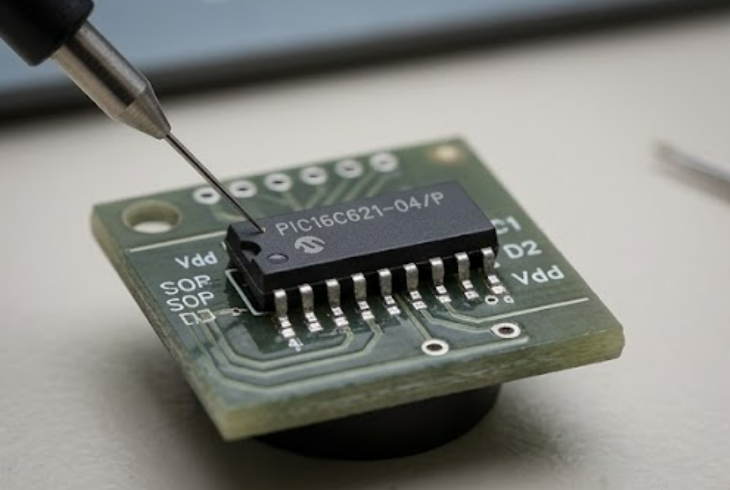
 The Microchip PIC16C621 stands as a pivotal evolution in embedded 8-bit architecture, bridging the gap between early microcontroller simplicity and modern industrial demands through its enhanced peripheral integration and robust memory subsystems. This secured device delivers 1K words of program FLASH, 128 bytes of data RAM, and dedicated EEPROM for non-volatile parameter storage—specifications that positioned it as the control brain across diverse sectors including automotive climate systems, industrial weighing scales, smart metering infrastructure, and security access panels. Its embedded analog comparator modules and precision timer arrays enabled designers to construct closed-loop control systems without external PLD supplementation, reducing bill-of-materials complexity while improving electromagnetic reliability. The PIC16C621’s protective code configuration bits allowed manufacturers to safeguard proprietary algorithms, yet this same locked security architecture now threatens operational continuity as original development teams disperse and documentation archives deteriorate. From conveyor belt controllers in food processing plants to infusion pump regulators in hospital wards, this microcontroller continues executing mission-critical logic that organizations cannot afford to lose.
Special Microcontroller Features (cont’d)
Programmable code protection
Power saving SLEEP mode
Selectable oscillator options
Serial in-circuit programming (via two pins)
Four user programmable ID locations
CMOS Technology:
· Low-power, high-speed CMOS EPROM technology
· Fully static design
· Wide operating voltage range
– PIC16C62X – 2.5V to 6.0V
– PIC16C62XA – 2.5V to 5.5V
– PIC16CR620A – 2.0V to 5.5V
· Commercial, industrial and extended temperature range
· Low power consumption
– < 2.0 mA @ 5.0V, 4.0 MHz
– 15 µA typical @ 3.0V, 32 kHz
– < 1.0 µA typical standby current @ 3.0V
GENERAL DESCRIPTION
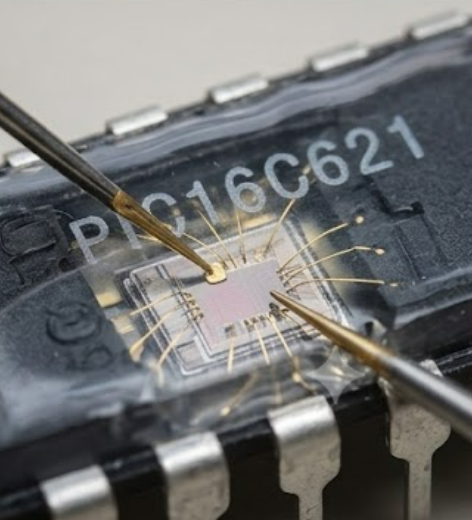
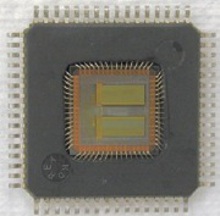
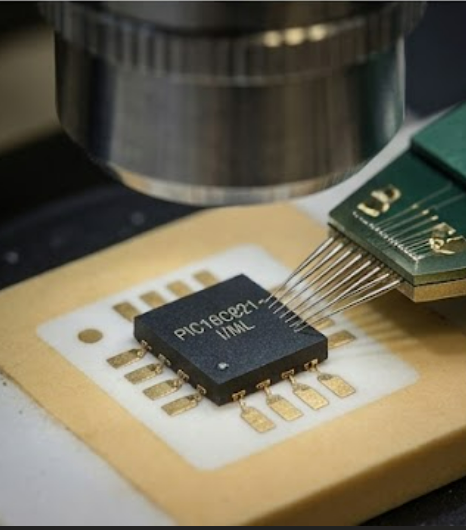
When a protected PIC16C621 requires program recovery, conventional debugging interfaces hit insurmountable walls erected by encrypted security fuses. The firmware trapped within these locked devices cannot be extracted through standard IC programmers or JTAG interfaces—Microchip‘s protective design intentionally severs communication pathways between external tools and internal memory arrays. Professional recovery operations demand sophisticated physical intervention: technicians decapsulate the chip package using precise chemical etching or mechanical milling to expose the silicon substrate beneath embedded bond wires. Once the die is visible, advanced probing stations attack specific circuit nodes with nanosecond-precision voltage pulses designed to break readout protection without corrupting the binary contents. This delicate hack circumvents secured boundaries by exploiting timing vulnerabilities or power-rail manipulation, ultimately enabling specialists to retrieve complete heximal and binary file representations from both FLASH and EEPROM regions. The extracted data then undergoes comprehensive decode processing to reconstruct functional logic, variable mappings, and operational states into human-readable engineering documentation.
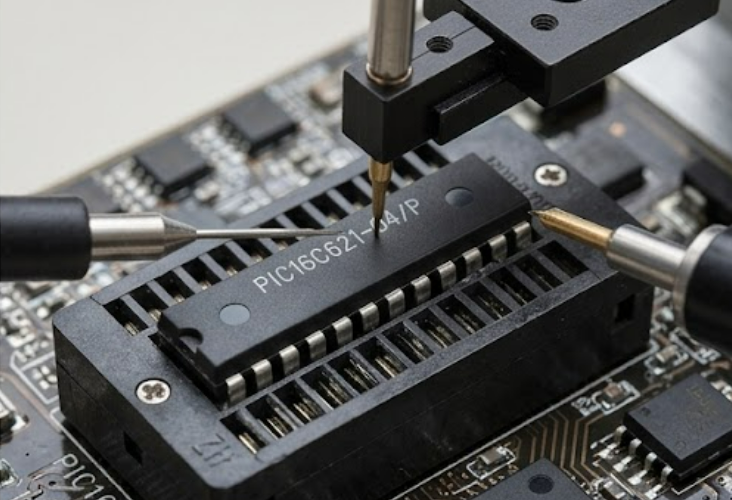
The PIC16C62X have enhanced core features, eight-level deep stack, and multiple internal and external interrupt sources. The separate instruction and data buses of the Harvard architecture allow a 14-bit wide instruction word with the separate 8-bit wide data.
The two-stage instruction pipeline allows all instructions to execute in a single-cycle, except for program branches (which require two cycles). A total of 35 instructions (reduced instruction set) are available. Additionally, a large register set gives some of the architectural innovations used to achieve a very high performance.
The driving force behind microcontrollerprogram recovery extends far beyond mere technical curiosity—it represents an economic lifeline for organizations managing aging infrastructure. Original equipment manufacturers frequently abandon obsolete product lines, leaving end users with locked silicon containing irreplaceable calibration tables, safety certification evidence, and proprietary control methodologies. Our clone and duplicate services transform this vulnerability into resilience by generating exact firmware replicas that preserve every bit of embedded operational intelligence. For automotive suppliers, recovering source code equivalents from encrypted engine management modules ensures compliance with emissions regulations without complete powertrain redesign. Industrial automation clients leverage recovered programarchives to fabricate replacement controllers for production lines where downtime costs exceed thousands of dollars hourly. Medical device manufacturers depend on precise duplicate capabilities to maintain FDA-validated therapeutic instruments whose protected software cannot be arbitrarily rewritten without triggering extensive re-certification protocols.
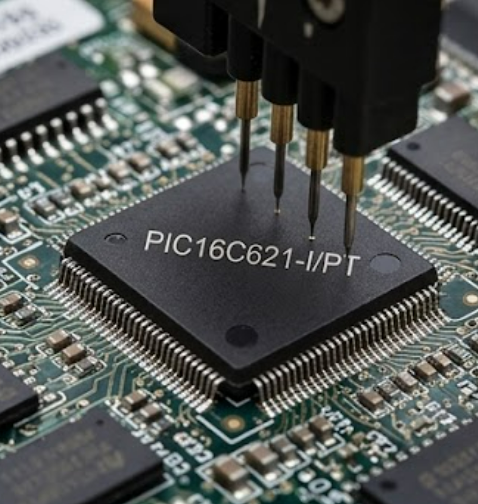
We specialize in comprehensive PIC16C621 recovery solutions that convert inaccessible locked silicon into fully documented engineering assets. Our cleanroom laboratories decapsulateprotected devices with surgical precision, while our proprietary fault-injection methodologies break even the most stringent secured configurations to retrieve intact memory contents. Whether you require immediate clone production for failed field units, duplicate generation for next-generation hardware migration, or complete decode services to reconstruct source code from raw binary file extractions, we deliver actionable results. Our technical team transforms encrypted firmware into comprehensive archive repositories—complete with heximal dumps, EEPROM data maps, and functional documentation—ensuring your embedded systems never again face extinction from irrecoverable program loss. Contact us to liberate your microcontroller intelligence and secure decades of continued operational excellence.
 Posted in Recover Chip