 Nordic NRF52833 MCU Source Code Duplication
 October 16th, 2026 |
  Author:
 Nordic NRF52833 MCU Source Code Duplication: Technical Analysis and Firmware Preservation
Nordic NRF52833 MCU Source Code Duplication is a specialized embedded-system engineering topic involving the analysis, preservation, and authorized reproduction of software information associated with the Nordic Semiconductor nRF52833. The nRF52833 is a multiprotocol 2.4 GHz wireless system-on-chip based on a 64 MHz Arm Cortex-M4 processor with floating-point support. It provides 512 KB Flash and 128 KB RAM, together with Bluetooth Low Energy, Bluetooth Mesh, Thread, Zigbee, 802.15.4, ANT, NFC-A, USB, ADC, PWM, timers, SPI, I2C, UART, and other integrated peripherals. Its combination of processing performance, wireless connectivity, memory capacity, and low-power operation makes it suitable for IoT equipment, industrial sensors, smart-home products, wearable devices, asset tracking systems, building automation, remote controls, and connected measurement equipment. For products already deployed in the field, understanding how the MCU firmware interacts with these integrated resources can be an important part of long-term product maintenance and engineering preservation.
Why Source-Code and Firmware Duplication Can Become Necessary
Embedded products frequently remain in service much longer than their original development environment. During this period, the original source code, software project, firmware backup, engineering archive, or programming documentation may become unavailable. A programmed MCU can consequently become one of the few remaining references to the software behavior of an established product. From an engineering perspective, Nordic NRF52833 MCU Source Code Duplication should not be regarded simply as copying a file. It involves determining what information remains available, understanding the relationship between firmware and hardware, and establishing whether an equivalent software image can be preserved for an authorized replacement or maintenance project.
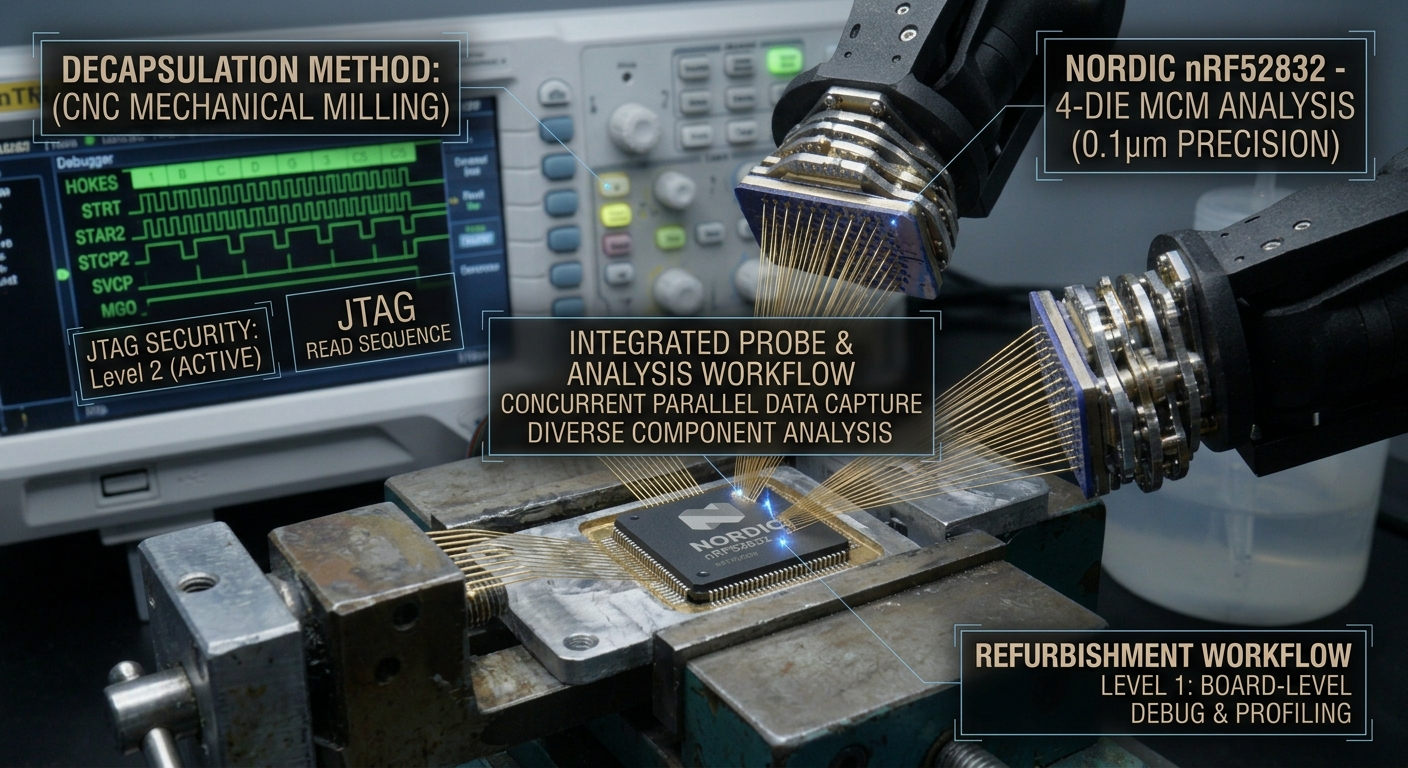
A particular challenge occurs when an nRF52833 has been configured with protective, secured, or locked access settings. Standard debugging or programming access may then be restricted, preventing straightforward inspection of internal memory. Engineers therefore need to establish the protection state before deciding on an appropriate technical route. Depending on the project, the objective may be to preserve a readable firmware image, compare different firmware versions, recover accessible data, or reproduce an existing software configuration on compatible hardware. This approach can reduce unnecessary redevelopment work when the original development resources are no longer available.
Technical Approach to NRF52833 Firmware Analysis
A Nordic NRF52833 MCU Source Code Duplication project generally begins with identification of the exact microcontroller and inspection of the complete electronic assembly. Engineers can examine the PCB layout, power architecture, SWD connections, external components, boot configuration, communication interfaces, and any external flash or eeprom devices. The internal memory arrangement of the nRF52833 is then considered together with the software architecture running on the device.
The next stage is to evaluate whether the available firmware, source code, software, memory, data, or archive information can be accessed and preserved. Where a legitimate firmware image is available, binary analysis can help identify application regions, configuration structures, communication routines, peripheral initialization, and relationships between the software and the physical chip. This information can be useful when developing a compatible replacement or verifying that a duplicated firmware image behaves consistently with the original design.
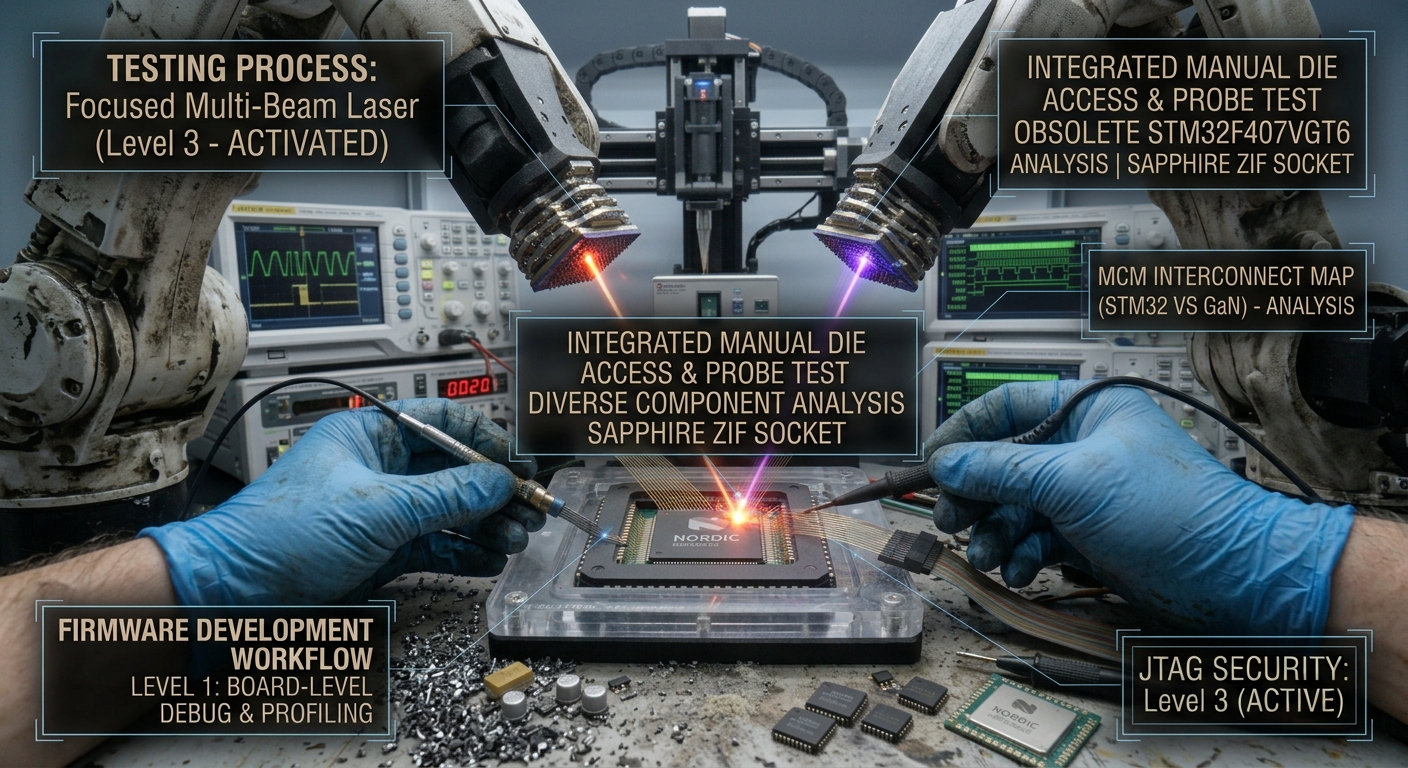
For protective, secured, encrypted, or locked devices, the investigation needs to distinguish between access protection and actual encryption. Technical terminology such as clone, attack, or decapsulate may arise in advanced semiconductor research, but these approaches should not be assumed to provide a universal solution. Any invasive semiconductor analysis should be considered only when technically justified and within the applicable authorization and legal framework. The practical result depends on the exact security configuration, device condition, available interfaces, and information retained inside the MCU.
Firmware Duplication for Embedded Product Continuity
The technical purpose of Nordic NRF52833 MCU Source Code Duplication is ultimately to preserve embedded functionality and support continuity of an electronic product. When an original firmware image can be legitimately obtained, duplication may allow engineers to maintain replacement controllers, compare production revisions, reproduce known software configurations, or investigate differences between functioning and defective boards. Firmware analysis can also help establish how wireless functions, sensors, user interfaces, communication peripherals, and other hardware resources are coordinated by the original software.
Professional MCU analysis can therefore combine hardware inspection, memory evaluation, firmware examination, binary comparison, and engineering documentation. The resulting information may support legacy product maintenance, replacement-board development, troubleshooting, and controlled reproduction of established electronic designs. It is important to recognize that source code and compiled firmware are not interchangeable: a recovered binary normally represents compiled program information rather than the original human-readable development project. Nevertheless, an accessible firmware image can provide valuable technical evidence about the original system.
A structured approach to Nordic NRF52833 MCU Source Code Duplication allows engineers to determine what information is realistically recoverable and how that information can contribute to an authorized engineering project. Rather than assuming that every protected MCU, microprocessor, chip, or IC can be duplicated, the analysis should begin with the actual device architecture and protection configuration. This provides a more reliable foundation for firmware preservation, product restoration, hardware replacement, and long-term support of Nordic-based embedded systems.
 Posted in Recover MCU