 Retrieve MCU NRF52832 Source Code
 October 16th, 2026 |
  Author:
 Retrieve MCU NRF52832 Source Code: Technical Analysis and Firmware Preservation
The Retrieve MCU NRF52832 Source code process involves analyzing an embedded wireless system to determine what software and memory information can be preserved from a programmed nRF52832 device. The nRF52832 is a multiprotocol system-on-chip from Nordic Semiconductor, built around a 64 MHz Arm Cortex-M4 processor with floating-point support. Depending on the device variant, it provides either 512 KB Flash with 64 KB RAM or 256 KB Flash with 32 KB RAM. The SoC integrates a 2.4 GHz radio, Bluetooth Low Energy, Bluetooth Mesh, NFC-A, ANT, multiple serial interfaces, PWM, ADC, PDM, I2S, timers, and hardware AES capabilities. These features make the nRF52832 suitable for IoT products, industrial sensor networks, smart-home equipment, building automation, wearable devices, remote controls, computer peripherals, beacons, and other connected electronic products.
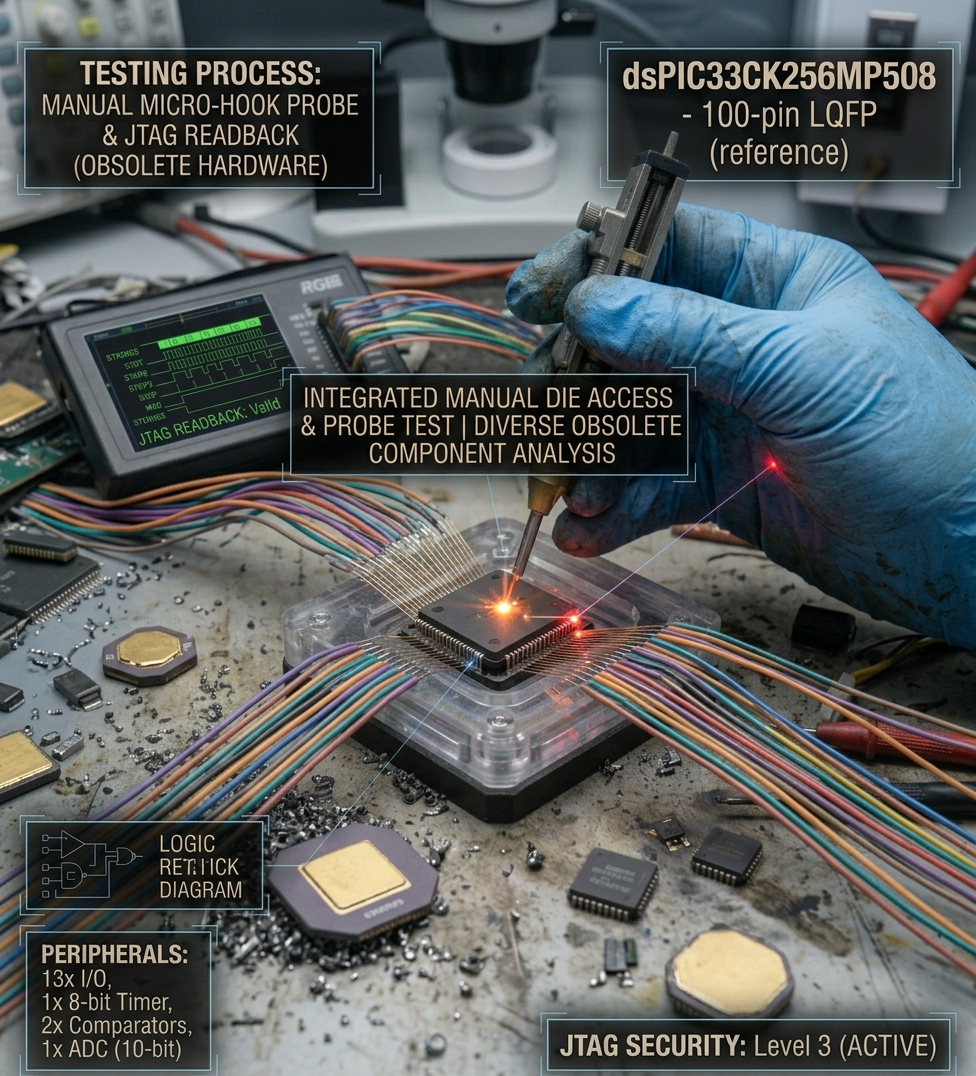
In a mature embedded product, firmware can represent much more than a simple executable program. It may contain application logic, wireless communication behavior, device configuration, calibration information, protocol implementation, and other data required for the system to operate correctly. Over the lifetime of a product, the original source code, development project, software package, engineering archive, or firmware backup may become unavailable. Consequently, investigating whether it is possible to retrieve MCU NRF52832 source code or preserve accessible program information can be valuable for legacy-system analysis, hardware replacement, firmware comparison, product maintenance, and technical restoration. The challenge becomes greater when the device has been configured with protective, secured, or locked access controls. Nordic’s documentation notes that access-port protection can block debugger read and write access to CPU registers and memory-mapped addresses, meaning that ordinary debugging access should not automatically be assumed to provide the original firmware.
Understanding the NRF52832 Memory and Protection Architecture
A technical Retrieve MCU NRF52832 Source code investigation normally starts with identification of the exact nRF52832 variant and examination of the surrounding hardware. Engineers can review the PCB, power arrangement, debug connections, boot configuration, external memories, and communication interfaces before assessing the internal memory architecture. The nRF52832 contains non-volatile flash for code and data storage and RAM for runtime operation; Nordic specifies different Flash/RAM combinations according to the device variant.
The next stage is to understand how the available debug and access mechanisms interact with the security configuration. A locked, secured, or otherwise protective device may behave differently from an unrestricted development device. Consequently, technical analysis should first determine whether accessible firmware, source code, software, memory, data, or other information can be preserved without unnecessarily altering the original hardware. The term readout should therefore be treated as an engineering objective rather than an assumption that all internal contents are accessible.
Technical Methods for Firmware and Source-Code Investigation
For Retrieve MCU NRF52832 Source code, engineers can evaluate available SWD access, device identification information, memory mapping, protection status, and the relationship between application firmware and Nordic software components. The nRF52832 supports SWD and includes a dedicated access-port architecture; Nordic documents that access-port protection can prevent debugger access to CPU registers and memory, while the behavior of protection mechanisms depends on the device build and configuration.
Depending on the authorized technical objective, the investigation may focus on recover, restore, and preserve accessible firmware or flash information. Where the original binary can legitimately be obtained, it can be analyzed as a reference for firmware structure, version comparison, hardware compatibility, or replacement-device development. If protection prevents conventional access, engineers need to distinguish between an access restriction and actual encrypted content. Terms such as decrypt, attack, or clone may appear in technical discussions of protected MCU analysis, but they should not be interpreted as evidence that a particular nRF52832 can always be bypassed or reproduced. More invasive semiconductor techniques such as decapsulate may be considered only in specialized circumstances after conventional engineering evaluation has been exhausted.
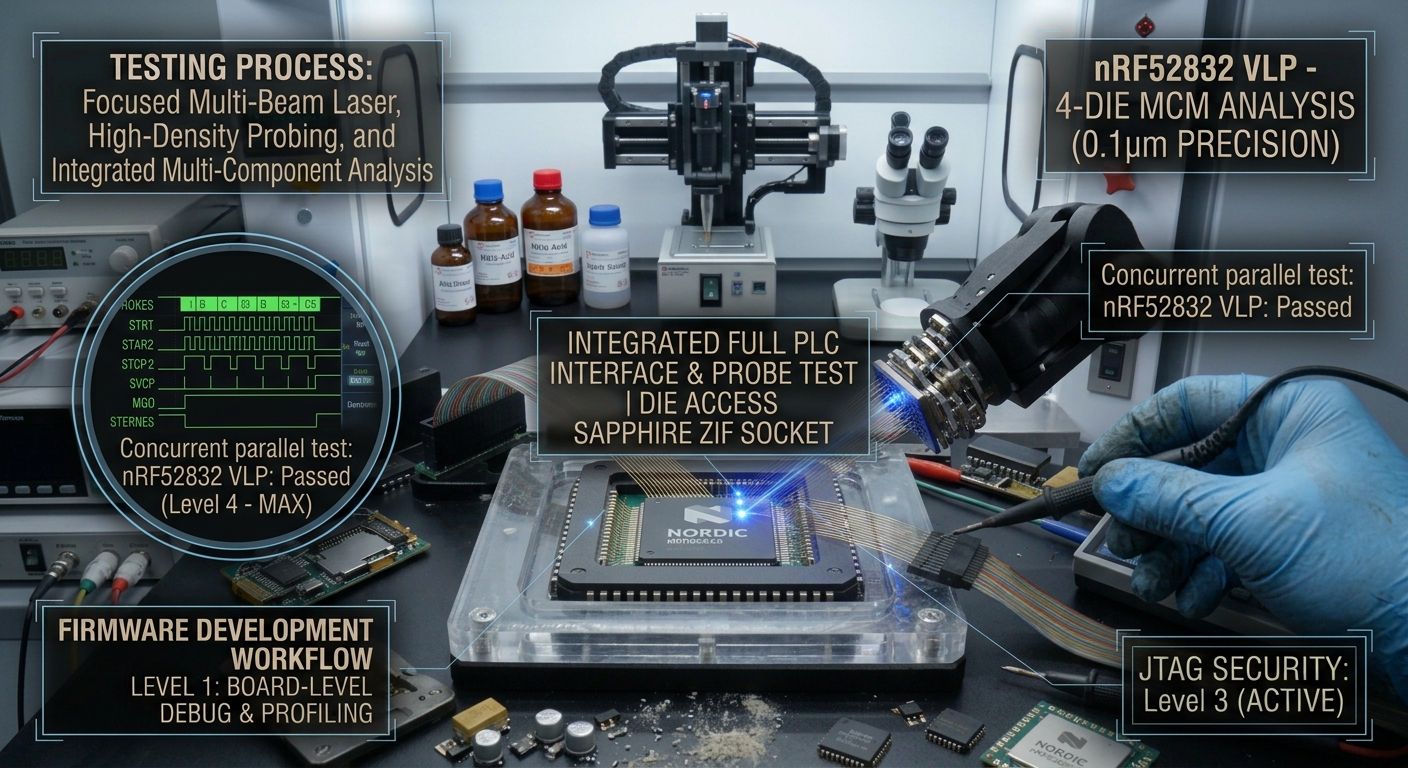
Supporting NRF52832 Firmware Preservation
The technical value of Retrieve MCU NRF52832 Source code extends beyond obtaining a single binary file. A recovered or otherwise accessible firmware image can provide engineers with information about wireless behavior, peripheral configuration, memory usage, communication protocols, and interaction between the software and the original PCB. This can be particularly useful when the original development archive has disappeared but an existing product remains available for examination.
A professional MCU analysis process can include hardware inspection, device identification, memory assessment, firmware examination, and documentation of accessible information. Such work can support authorized product maintenance, legacy-device restoration, replacement-board engineering, and preservation of embedded technology. The ultimate result depends on the nRF52832 variant, physical condition, protection configuration, available interfaces, and the information that remains accessible. Therefore, Retrieve MCU NRF52832 Source code should be approached as a structured technical investigation, with realistic expectations about what can and cannot be recovered from a protected device.
 Posted in Recover Chip