Archive for the ‘Break IC’ Category
 Restricting access to information on memory programming
 November 20th, 2012 |
  Author:
 Another simple trick many semiconductor manufacturers use is restricting access to information on memory programming. This is normally used for smartcards, but on some microcontrollers such information is not publicly available as well. This is not a reliable and practical way of making the design secure. Of course it works well with smartcards where all the customers are obliged to sign a non-disclosure agreement with the chip manufacturer. But microcontrollers, with very few exceptions, can be programmed with universal programmers that are widely available from different companies around the world. Even if the programming specification is not documented, all the necessary waveforms can be easily extracted in a few hours with using any low cost oscilloscope, because all the signals are normally applied with less than 1 MHz frequency. If the microcontroller is not supported by a particular universal programmer, it is always possible to buy the development kit directly from the manufacturer and obtain all the necessary protocols from it directly.
Distinguish the whether an IC is ASIC
A determined IC attacker could try an easy way to check whether this chip was actually an ASIC. The easy way is to note which pins are connected to power supply, ground, clock, reset, serial, and other interfaces, and to compare all this information with the database of suspect microcontrollers or other mcus. This works very reliably, as each microcontroller family has its own characteristic pinout. Once similarities are found the suspected microcontroller could be verified by placing it into a programming device or universal programmer and trying to read it.
Attack Custom IC
Attack Custom IC which has specific memory structure and system different from standard Microchip, ATMEL microcontroller to extract code from MCU memory, reverse engineering custom IC can help to figure out the internal structure of custom IC;
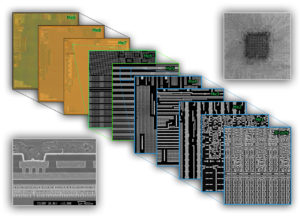
Attack Custom IC which has specific memory structure and system different from standard Microchip, ATMEL microcontroller to extract code from MCU memory, reverse engineering custom IC can help to figure out the internal structure of custom IC
Semiconductor manufacturers offer valuable customers an easy way to increase the protection of their products: chips with custom marking on the packages instead of standard chip names. That gives the impression that the final product was designed using ASICs or full custom ICs. ‘Everyone knows’ that ASICs offer very good protection against different sorts of attacks and only well equipped and highly skilled attackers could succeed with breaking them. This may stop many potential attackers fiddling with the product.
 Posted in Break IC |
  Tags: crack custom ic, decrypt custom ic, extract custom ic, hack custom ic |
  Comments Closed
Decrypt Secured MCU ATmega128P Code
We can decrypt secured MCU ATMEGA128P code, please view the secured MCU ATMEGA128P features for your reference:
The following charts show typical behavior. These data are characterized but not tested. All current consumption measurements are performed with all I/O pins configured as inputs and with internal pull-ups enabled.
The current consumption is a function of several factors such as: Operating voltage, operating frequency, loading of I/O pins, switching rate of I/O pins, code executed and ambient temperature. The dominating factors are operating voltage and frequency if Decrypt Secured MCU ATMEGA128P Code.
The current drawn from capacitive loaded pins may be estimated (for one pin) as CL·VCC·f where CL = load capacitance, VCC = operating voltage and f = average switching frequency of I/O pin.
The difference between current consumption in Power-down mode with Watchdog Timer enabled and Power-down mode with Watchdog Timer disabled represents the differential current drawn by the Watchdog Timer after Decrypt Secured MCU ATMEGA128P Code.
The ATMEGA128P is a low-power, high-performance CMOS 8-bit microcomputer with 12K bytes of Downloadable Flash codemable and erasable read only memory.
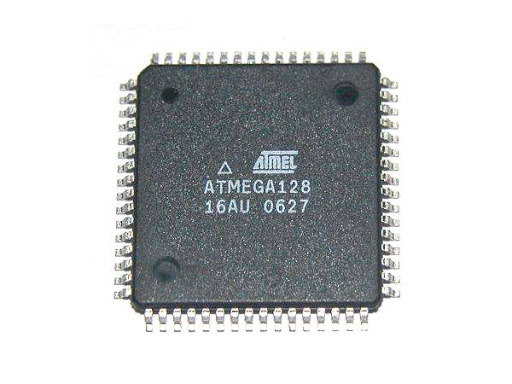
The device is manufactured using Atmel’s high density nonvolatile memory technology and is compatible with the industry standard 80C51 instruction set and pinout.
The onsecured MCU Downloadable Flash allows the code memory to be recodemed in-system through an SPI serial interface or by a conventional nonvolatile memory codemer before Decrypt Secured MCU ATMEGA128P Code.
Smartcard attacker fight with service provider
Smartcard attack will not be so expensive, because pirate devices are normally based on standard microcontrollers which have much lower security protection than pay-TV smartcards. Very likely the device will be cracked in a few weeks, and the secondary attackers will flood the market with their clones. Fairly soon, the information on how to build pirate devices becomes available on the Internet and anyone can build pirate devices at almost no cost. So the pay-TV service provider loses millions of dollars; sometimes the original attacker is sued or prosecuted. But because the lost profit was distributed among all the pirates and dishonest subscribers, the service provider hardly gets any money back. The only effect of such actions is to threaten the hacker community with punishment. In addition the service provider will have to spend a fortune on redesigning his access control system, choosing and developing software for the new smartcard, and distributing cards to the subscribers
Posted in Break IC |
Tags: decode smartcard, discover smartcard, hack smartcard, recover smartcard |
Comments Closed
Pay-TV access card attack
Another example is when the smartcard attacker invests a huge amount of money to reverse engineer a pay-TV access card. Then he disassembles the internal code from the card, learning everything that happens during authorisation and operation. Very likely he would be able to find vulnerabilities which give unlimited access to the subscription channels, for example, by applying a power glitch at just the right moment to cause a malfunction of the CPU. Once he succeeded he could either offer the subscription service at a very competitive price, or sell equipment for counterfeiting the card to malicious people. Obviously such an attacker needs to invest some capital to do this. But once he launches a pirate device on the market, it will be attacked by others.
Posted in Break IC |
Tags: break smartcard, decrypt smartcard, extract smartcard, smartcard attack, smartcard crack |
Comments Closed
Decrypt Locked MCU ATMEGA128V Embedded Firmware
We can decrypt locked MCU ATMEGA128V embedded firmware, please view the locked MCU ATMEGA128V features for your reference:
If desired, ALE operation can be disabled by setting bit 0 of SFR location 8EH. With the bit set, ALE is active only during a MOVX or MOVC instruction. Otherwise, the pin is weakly pulled high. Setting the ALE-disable bit has no effect if the microcontroller is in external execution mode.
Program Store Enable is the read strobe to external program memory. When the AT89S53 is executing embedded firmware from external program memory, PSEN is activated twice each machine cycle, except that two PSEN activations are skipped during each access to external data memory before Decrypt Locked MCU ATMEGA128V Embedded Firmware.
External Access Enable. EA must be strapped to GND in order to enable the device to fetch embedded firmware from external program memory locations starting at 0000H up to FFFFH. Note, however, that if lock bit 1 is programmed, EA will be internally latched on reset.
EA should be strapped to VCC for internal program executions. This pin also receives the 12-volt programming enable voltage (VPP) during Flash programming when 12-volt programming is selected.
A map of the on-chip memory area called the Special Function Register (SFR) space is shown in Table 1. Note that not all of the addresses are occupied, and unoccupied addresses may not be implemented on the chip when Decrypt Locked MCU ATMEGA128V Embedded Firmware.
Read accesses to these addresses will in general return random data, and write accesses will have an indeterminate effect. User software should not write 1s to these unlisted locations, since they may be used in future products to invoke new features. In that case, the reset or inactive values of the new bits will always be 0.
Timer 2 Registers Control and status bits are contained in registers T2CON (shown in Table 2) and T2MOD (shown in Table 9) for Timer 2. The register pair (RCAP2H, RCAP2L) are the Capture/Reload registers for Timer 2 in 16 bit capture mode or 16-bit auto-reload mode before Decrypt Locked MCU ATMEGA128V Embedded Firmware.
Watchdog Control Register The WCON register contains control bits for the Watchdog Timer (shown in Table 3). The DPS bit selects one of two DPTR registers available after BREAK IC.
Break MCU ATMEGA2560PV Code
We can break MCU ATMEGA2560PV code, please view the MCU ATMEGA2560PV features for your reference:
Timer 2 is a 16 bit Timer/Counter that can operate as either a timer or an event counter. The type of operation is selected by bit C/T2 in the SFR T2CON (shown in Table 2). Timer 2 has three operating modes: capture, auto-reload (up or down counting), and baud rate generator.
The modes are selected by bits in T2CON, as shown in Table 8. Timer 2 consists of two 8-bit registers, TH2 and TL2. In the Timer function, the TL2 register is incremented every machine cycle. Since a machine cycle consists of 12 oscillator periods, the count rate is 1/12 of the oscillator frequency if Break MCU ATMEGA2560PV Code.
In the Counter function, the register is incremented in response to a 1-to-0 transition at its corresponding external input pin, T2. In this function, the external input is sampled during S5P2 of every machine cycle. When the samples show a high in one cycle and a low in the next cycle, the count is incremented.
The new count value appears in the register during S3P1 of the cycle following the one in which the transition was detected. Since two machine cycles (24 oscillator periods) are required to recognize a 1-to-0 transition, the maximum count rate is 1/24 of the oscillator frequency after Break MCU ATMEGA2560PV Code.
To ensure that a given level is sampled at least once before it changes, the level should be held for at least one full machine cycle. In the capture mode, two options are selected by bit EXEN2 in T2CON. If EXEN2 = 0, Timer 2 is a 16 bit timer or counter which upon overflow sets bit TF2 in T2CON.
This bit can then be used to generate an interrupt. If EXEN2 = 1, Timer 2 performs the same operation, but a l to-0 transition at external input T2EX also causes the current value in TH2 and TL2 to be captured into RCAP2H and RCAP2L, respectively if break MCU code.
In addition, the transition at T2EX causes bit EXF2 in T2CON to be set. The EXF2 bit, like TF2, can generate an interrupt after Break MCU ATMEGA2560PV Code.
Discover IC Flash
Discover IC Flash content from embedded flash memory of Microcontroller, disable the security fuse bit by crack MCU with focus ion beam technique;
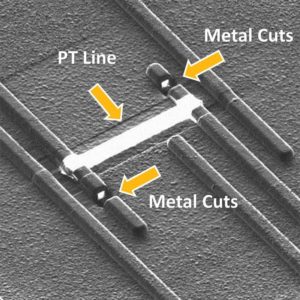
Discover IC Flash content from embedded flash memory of Microcontroller, disable the security fuse bit by crack MCU with focus ion beam technique;
One example of a simple non-invasive chip firmware discovery could be cloning a device based on SRAM FPGA as it is configured at a power-up. The ic attacker could easily connect to the JTAG interface wires used for configuring the chip and, with either an oscilloscope or a logic analyser, grab all the signals. Then he can thoroughly analyse the waveforms and replay the commands in his own design.
He could also slightly change the bitstream to disguise the fact of cloning as usually only half of the FPGA resources are used, leaving a room to fiddle with the configuration without harming device operation. Also the JTAG interface itself gives some freedom in the sequence of the signals being applied so that the waveforms used to configure the pirate copy will look different from the original. In addition, the ic breaker could mix the row addresses during the upload, giving the impression of a completely different design.
Posted in Break IC |
Tags: cpld flash discover, cypress ic flash discover, dsp flash discover, dsp mcu flash discover, fpga flash discover, mcu flash discover, pld flash discover |
Comments Closed
Copy IC Flash
Copy IC Flash program file and eeprom data file from MCU memory, unlock encrypted Microcontroller memory and readout the embedded firmware inside it;
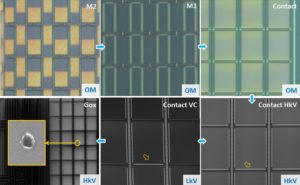
Copy IC Flash program file and eeprom data file from MCU memory, unlock encrypted Microcontroller memory and readout the embedded firmware inside it;
Non-invasive IC Flash copy can be either passive or active. Passive ic attacks, also called side-channel ic decryptions, do not involve any interaction with the attacked device but, usually, observation of its signals and electromagnetic emissions. Examples of such ic breaks are power analysis and timing ic flash copys. Active ic extracts, like brute force and glitch attacks, involve playing with the signals applied to the device including the power supply line.
Posted in Break IC |
Tags: cpld flash copy, cypress ic flash copy, dsp flash copy, dsp mcu flash copy, fpga flash copy, mcu flash copy, pld flash copy |
Comments Closed