 Extract Chip PIC16C57 Heximal File
 June 25th, 2010 |
  Author:
 Extract Chip PIC16C57 Heximal File from flash memory, original programmed MCU pic16c57 will be readout and program/data from flash/eeprom of microcontroller pic16c57 can be duplicated;
A fetch cycle begins with the program counter (PC) incrementing in Q1. In the execution cycle, the fetched instruction is latched into the Instruction Register (IR) in cycle Q1.
This instruction is then decoded and executed during the Q2, Q3, and Q4 cycles. Data memory is extract during Q2 (operand extract) and written during Q4 (destination write) if recover pic16c554 memory software.
All instructions are single cycle, except for any program branches. These take two cycles since the fetch instruction is “flushed” from the pipeline while the new instruction is being fetched and then executed.
PIC16C57 memory is organized into program memory and data memory. For devices with more than 512 bytes of program memory, a paging scheme is used after recover microcontroller pic16f83 eeprom.
Program memory pages are accessed using one STATUS register bit. For the PIC16C57 with a data memory register file of more than 32 registers, a banking scheme is used.
Data memory banks are accessed using the File Select Register (FSR). The PIC16C57 devices have a 12-bit Program Counter (PC) capable of addressing a 2K x 12 program memory space. Only the first 512 x 12 (0000h-01FFh) for the PIC16C57 and 1K x 12 (0000h-03FFh) for the PIC16C57 are physically implemented before copy epm9320arc208 cpld jed file.
Refer to Figure 4-1. Accessing a location above these boundaries will cause a wrap around within the first 512 x 12 space (PIC16C57) or 1K x 12 space (PIC16C57).
The effective reset vector is at 000h, (see Figure 4-1). Location 01FFh (PIC16C57) or location 03FFh (PIC16C57) contains the internal clock oscillator calibration value. This value should never be overwritten.
 Posted in Recover Chip |
  Tags: decap microcontroller bin, decap microcontroller code, decap microcontroller data, decap microcontroller eeprom, decap microcontroller file, decap microcontroller firmware, decap microcontroller hex, decap microcontroller information, decap microcontroller memory, decap microcontroller program, decap microcontroller software |
  Comments Closed
Break MCU ATmega64PA Binary
Break MCU ATmega64PA and readout the embedded Binary from microcontroller atmega64pa flash memory, fuse bit of mcu atmega64pa will be crack to disable the protection;
The ATmega64 is a highly complex mcu where the number of I/O locations supersedes the 64 I/O location reserved in the AVR instruction set. To ensure backward compatibility with the ATmega103, all I/O locations present in ATmega103 have the same location in ATmega64. Most additional I/O locations are added in an Extended I/O space starting from 0x60 to 0xFF (i.e., in the ATmega103 internal RAM space). These location can be reached by using LD/LDS/LDD and ST/STS/STD instructions only, not by using IN and OUT instructions. The relocation of the internal RAM space may still be a problem for ATmega103 users.
Also, the increased number of Interrupt Vectors might be a problem if the code uses absolute addresses. To solve these problems, an ATmega103 compatibility mode can be selected by programming the fuse M103C. In this mode, none of the functions in the Extended I/O space are in use, so the internal RAM is located as in ATmega103. Also, the extended Interrupt Vectors are removed. The ATmega64 is 100% pin compatible with ATmega103, and can replace the ATmega103 on current printed circuit boards. The application notes “Replacing ATmega103 by ATmega128” and “Migration between ATmega64 and ATmega128” describes what the user should be aware of replacing the ATmega103 by an ATmega128 or ATmega64PA.
By programming the M103C Fuse, the ATmega64 will be compatible with the ATmega103 regards to RAM, I/O pins and Interrupt Vectors as described above. However, some new features in ATmega64 are not available in this compatibility mode, these features are listed:
Pin Descriptions
One USART instead of two, asynchronous mode only. Only the eight least significant bits of the Baud Rate Register is available. One 16 bits Timer/Counter with two compare registers instead of two 16 bits Timer/Counters with three compare registers. Two-wire serial interface is not supported.
Port G serves alternate functions only (not a general I/O port). Port F serves as digital input only in addition to analog input to the ADC. Boot Loader capabilities is not supported. It is not possible to adjust the frequency of the internal calibrated RC Oscillator. The External Memory Interface can not release any Address pins for general I/O, neither configure different wait states to different External Memory Address sections. Only EXTRF and PORF exist in the MCUCSR Register. No timed sequence is required for Watchdog Timeout change. Only low-level external interrupts can be used on four of the eight External Interrupt sources. Port C is output only. USART has no FIFO buffer, so Data OverRun comes earlier. The user must have set unused I/O bits to 0 in ATmega103 programs after Break IC.
Posted in Break IC |
Tags: break mcu encrypted archive, break mcu encrypted code, break mcu encrypted content, break mcu encrypted data, break mcu encrypted eeprom, break mcu encrypted file, break mcu encrypted firmware, break mcu encrypted information, break mcu encrypted memory, break mcu encrypted program |
Comments Closed
Copy Protected Chip PIC16C56 Code
Copy Protected Chip PIC16C56 Code include program of flash and data of eeprom memory, the embedded source code of microcontroller pic16c56 will be replicated after readout frm mcu pic16c56 memory;
The PIC12C5XX device contains an 8-bit ALU and working register. The ALU is a general purpose arithmetic unit. It performs arithmetic and Boolean functions between data in the working register and any register file when attack mcu attiny2313 memory for its firmware.
The ALU is 8-bits wide and capable of addition, subtraction, shift and logical operations. Unless otherwise mentioned, arithmetic operations are two’s complement in nature.
In two-operand instructions, typically one operand is the W (working) register. The other operand is either a file register or an immediate constant before Copy avr mcu atmega165a memory.
In single operand instructions, the operand is either the W register or a file register. The W register is an 8-bit working register used for ALU operations.
It is not an addressable register. Depending on the instruction executed, the ALU may affect the values of the Carry (C), Digit Carry (DC), and Zero (Z) bits in the STATUS register.
The C and DC bits operate as a borrow and digit borrow out bit, respectively, in subtraction. See theSUBWF andADDWF instructions for examples if copy mcu atmega162 flash memory.
A simplified block diagram is shown in Figure 3-1, with the corresponding device pins described in Table 3-1. The PIC12C5XX can directly or indirectly address its register files and data memory.
All special function registers including the code counter are mapped in the data memory. The PIC12C5XX has a highly orthogonal (symmetrical) instruction set that makes it possible to carry out any operation on any register using any addressing mode. This symmetrical nature and lack of ‘special optimal situations’ make codeming with the PIC12C5XX simple yet efficient. In addition, the learning curve is reduced significantly.
Posted in Reverse Engineer Microcontroller |
Tags: copy protected chip binary, copy protected chip code, copy protected chip data, copy protected chip eeprom, copy protected chip file, copy protected chip firmware, copy protected chip heximal, copy protected chip memory, copy protected chip program, copy protected chip software |
Comments Closed
Open Microcontroller PIC12LC509A Security bits
Open Microcontroller PIC12LC509A and extract embedded firmware from mcu pic12lc509a flash memory, Security bits will be decrypted to disable the protection on the microprocessor 12lc509a;
Microchip offers a unique programming service where a few user-defined locations in each device are programmed with different serial numbers when recover microcontroller stm32f105rct6 binary.
The serial numbers may be random, pseudo-random or sequential. Serial programming allows each device to have a unique number which can serve as an entry-code, password or ID number.
The high performance of the PIC12C5XX family can be attributed to a number of architectural features commonly found in RISC microprocessors.
To begin with, the PIC12C5XX uses a Harvard architecture in which program and data are accessed on separate buses. This improves bandwidth over traditional von Neumann architecture where program and data are fetched on the same bus.
Separating program and data memory further allows instructions to be sized differently than the 8-bit wide data word. Instruction opcodes are 12-bits wide making it possible to have all single word instructions when break microcontroller atmega128 heximal.
A 12-bit wide program memory access bus fetches a 12-bit instruction in a single cycle. A two-stage pipeline overlaps fetch and execution of instructions. Consequently, all instructions (33) execute in a single cycle (1µs @ 4MHz) except for program branches.
The table below lists program memory (EPROM), data memory (RAM), ROM memory, and non-volatile (EEPROM) for each device.
The PIC12C5XX can directly or indirectly address its register files and data memory. All special function registers including the program counter are mapped in the data memory. The PIC12C5XX has a highly orthogonal (symmetrical) instruction set that makes it possible to carry out any operation on any register using any addressing mode.
This symmetrical nature and lack of ‘special optimal situations’ make programming with the PIC12C5XX simple yet efficient. In addition, the learning curve is reduced significantly.
Posted in Recover Chip |
Tags: open locked microcontroller bin, open locked microcontroller data, open locked microcontroller eeprom, open locked microcontroller file, open locked microcontroller firmware, open locked microcontroller flash, open locked microcontroller hex, open locked microcontroller memory, open locked microcontroller program, open locked microcontroller software |
Comments Closed
Recover IC PIC12LC508A Eeprom
Recover IC PIC12LC508A Eeprom needs to unlock mcu pic12lc508a protection and then extract the firmware from microcontroller pic12lc508a flash and eeprom memory;
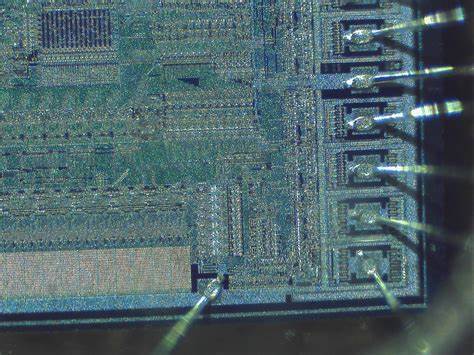
A variety of packaging options are available. Depending on application and production requirements, the proper device option can be selected using the information in this section.
When placing orders, please use the PIC12C5XX Product Identification System at the back of this data sheet to specify the correct part number if copy mcu pic16c554a eeprom.
The UV erasable version, offered in ceramic side brazed package, is optimal for prototype development and pilot programs. before production shipments are available. Please contact your local Microchip Technology sales office for more details.
The UV erasable version can be erased and reprogrammed to any of the configuration modes.
Note: Please note that erasing the device will also erase the pre-programmed internal calibration value for the internal oscillator after copy microcontroller pic16c76 hex.
The calibration value must be saved prior to erasing the part. Microchip’s PICSTART® PLUS and PRO MATE® programmers all support programming of the PIC12C5XX.
Third party programmers also are available;
Microchip Third Party Guide for a list of sources. The availability of OTP devices is especially useful for customers who need the flexibility for frequent eeprom updates or small volume applications.
The OTP devices, packaged in plastic packages permit the user to program them once. In addition to the program memory, the configuration bits must also be programmed before Recover IC atmega64l eeprom.
Microchip offers a QTP Programming Service for factory production orders. This service is made available for users who choose not to program a medium to high quantity of units and whose eeprom patterns have stabilized.
The devices are identical to the OTP devices but with all EPROM locations and fuse options already programmed by the factory. Certain eeprom and prototype verification procedures do apply before production shipments are available.
Posted in Recover Chip |
Tags: decrypt chip bin, decrypt chip code, decrypt chip data, decrypt chip eeprom, decrypt chip file, decrypt chip firmware, decrypt chip fuse bits, decrypt chip heximal, decrypt chip memory, decrypt chip program, decrypt chip security bits, decrypt chip software |
Comments Closed
Extract Chip PIC12LF510 Code
Extract Chip PIC12LF510 code from embedded flash memory, the firmware conside inside locked mcu pic12lf510 will be readout after crack microcontroller;
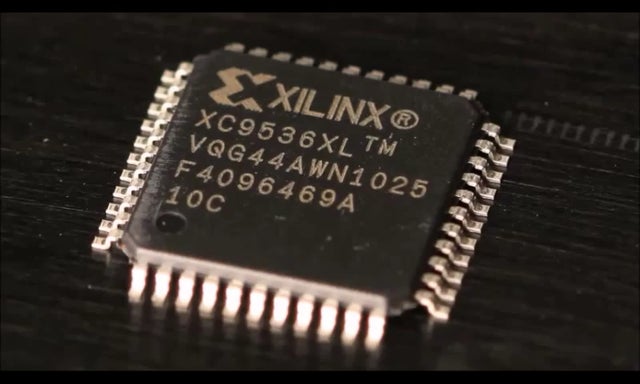
The PICkit™ 2 Development Programmer is a low-cost programmer with an easy-to-use interface for programming many of Microchip ’s baseline, mid-range and PIC18F families of Flash memory.
The PICkit 2 Starter Kit includes a prototyping development board, twelve sequential lessons, software and HI-TECH’s PICC™ Lite C compiler, and is designed to help get up to speed quickly using PIC® break mcu pic16f631 flash memory.
The kit provides everything needed to program, evaluate and develop applications using Microchip ’s powerful, mid-range Flash memory family.
A wide variety of demonstration, development and evaluation boards for various PIC MCUs and dsPIC DSCs allows quick application development on fully functional systems if break microcontroller pic16f628a.
Most boards include prototyping areas for adding custom circuitry and provide application firmware and source code for examination and modification after Extract Chip code.
The boards support a variety of features, including LEDs, temperature sensors, switches, speakers, RS-232 interfaces, LCD displays, potentiometers and additional EEPROM memory.
The demonstration and development boards can be used in teaching environments, for prototyping custom circuits and for learning about various Chip applications after Extract attack mcu pic16f711 hex.
In addition to the PICDEM™ and dsPICDEM™ demonstration/development board series of circuits, Microchip has a line of evaluation kits and demonstration software for analog filter design, KEELOQ® security ICs, CAN, IrDA®, PowerSmart® battery management, SEEVAL® evaluation system, Sigma-Delta ADC, flow rate sensing, plus many more.
Check the Microchip web page (www.microchip .com) and the latest “Product Selector Guide” (DS00148) for the complete list of demonstration, development and evaluation kits.
Posted in Reverse Engineer Microcontroller |
Tags: open mcu bin, open mcu data, open mcu eeprom, open mcu file, open mcu firmware, open mcu hex, open mcu memory, open mcu program, open mcu software |
Comments Closed
Copying Chip PIC12LF510 Program
Copying Chip PIC12LF510 Program from flash memory, the secured microcontroller will be unlocked and readout the embedded firmware heximal file from mcu pic12lf510;
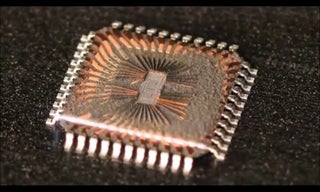
The PICkit™ 2 Development Programmer is a low-cost programmer with an easy-to-use interface for programming many of Microchip’s baseline, mid-range and PIC18F families of Flash memory.
The PICkit 2 Starter Kit includes a prototyping development board, twelve sequential lessons, software and HI-TECH’s PICC™ Lite C compiler, and is designed to help get up to speed quickly using PIC® copying dsp mcu tms320lf2401avfa program.
The kit provides everything needed to program, evaluate and develop applications using Microchip’s powerful, mid-range Flash memory family of chip copying.
A wide variety of demonstration, development and evaluation boards for various PIC MCUs and dsPIC DSCs allows quick application development on fully functional systems if Copying microcontroller pic16c711 firmware.
Most boards include prototyping areas for adding custom circuitry and provide application firmware and source code for examination and modification.
The boards support a variety of features, including LEDs, temperature sensors, switches, speakers, RS-232 interfaces, LCD displays, potentiometers and additional EEPROM memory.
The demonstration and development boards can be used in teaching environments, for prototyping custom circuits and for learning about various chip applications after recover mcu pic16c73b firmware.
In addition to the PICDEM™ and dsPICDEM™ demonstration/development board series of circuits, Microchip has a line of evaluation kits and demonstration software for analog filter design, KEELOQ® security ICs, CAN, IrDA®, PowerSmart® battery management, SEEVAL® evaluation system, Sigma-Delta ADC, flow rate sensing, plus many more.
Check the Microchip web page (www.microchip.com) and the latest “Product Selector Guide” (DS00148) for the complete list of demonstration, development and evaluation kits.
Posted in Recover Chip |
Tags: copying chip bin, copying chip code, copying chip data, copying chip eeprom, copying chip file, copying chip firmware, copying chip hex, copying chip memory, copying chip program, copying chip security bit, copying chip software |
Comments Closed
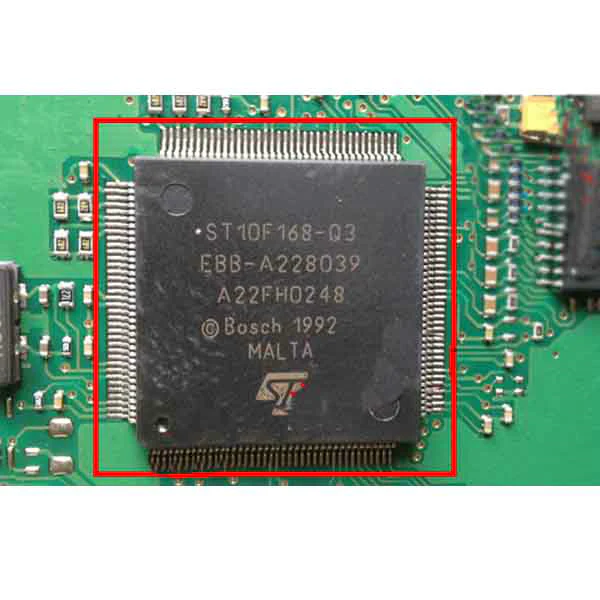
Copy Chip ST10F168SQ6 Software
The STMicroelectronics ST10F168 family is a widely used 16/32-bit microcontroller line built for demanding automotive, industrial, and control applications. When the need arises to copy chip ST10F168SQ6 software — whether to restore lost firmware, duplicate legacy systems, or audit a protected embedded program — professional, careful handling is essential. We offer a service to help end users readout, analyze, and recover the firmware/binary/heximal data stored in ST10F168 devices while prioritizing legality and data integrity.
Why clients need this service
Devices using the ST10F168 often contain critical program files, calibration data, or archived memory essential to system operation. Common legitimate reasons to request a firmware copy include:
- Restore corrupted or accidentally erased flash/eeprom files.
- Duplicate/clone firmware for legitimate manufacturing backups or legacy system support.
- Migrate software to replacement hardware during maintenance or upgrades.
- Audit and verify embedded software for safety and compliance.
Copy Chip ST10F168SQ6 Software from its encrypted flash and eeprom memory, extract MCU firmware and make microcontroller st10f168sq6 cloning units;
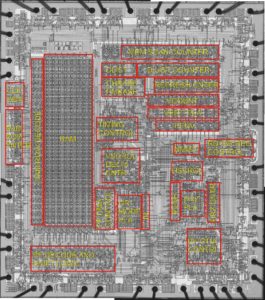
HIGH PERFORMANCE CPU
– 16-BIT CPU WITH 4-STAGE PIPELINE
– 80ns INSTRUCTION CYCLE TIME AT 25MHz CPU CLOCK
– 400ns 16 X 16-BIT MULTIPLICATION
– 800ns 32 / 16-BIT DIVISION
– ENHANCED BOOLEAN BIT MANIPULATION FACILITIES
– ADDITIONAL INSTRUCTIONS TO SUPPORT HLL AND OPERATING SYSTEMS
– SINGLE-CYCLE CONTEXT SWITCHING SUP-
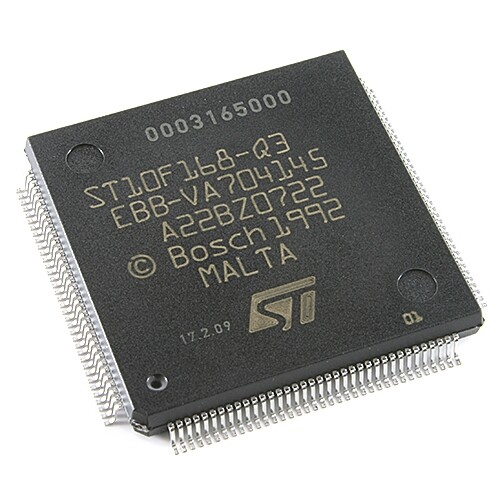
PQFP144 (28 x 28 mm) (Plastic Quad Flat Pack)
PORT A/D CONVERTER
MEMORY ORGANIZATION
– 256K BYTE ON-CHIP FLASH MEMORY
– 10K ERASING / PROGRAMMING CYCLES
– UP TO 16M BYTE LINEAR ADDRESS SPACE
FOR CODE AND DATA (5M BYTE WITH CAN) when break microcontroller s3f9454 software
– 2K BYTE ON-CHIP INTERNAL RAM (IRAM)
– 6K BYTE ON-CHIP EXTENSION RAM (XRAM)
– 20 YEAR DATA RETENTIO N TIME
FAST AND FLEXIBLE BUS
– PROGRAMMABLE EXTERNAL BUS CHARAC-
TE- RISTICS FOR DIFFERENT ADDRESS RANGES
– 8-BIT OR 16-BIT EXTERNAL DATA BUS
– MULTIPLEXED OR DEMULTIPLEXED EXTER-NAL ADDRESS / DATA BUSES
– FIVE PROGRAMMABLE CHIP-SELECT SIGNALS
– HOLD-ACKNOWLEDGE BUS ARBITRATION SUPPORT INTERRUPT
– 16-CHANNEL 10-BIT after read microchip mcu pic32mx440f512h bin
– 7.76µS CONVERSION TIME
FAIL-SAFE PROTECTIO N
– PROGRAMMABLE WATCHDOG TIMER
– OSCILLATOR WATCHDOG
ON-CHIP CAN 2.0B INTERFACE
ON-CHIP BOOTSTR AP LOADER
CLOCK GENERATION
– ON-CHIP PLL
– DIRECT OR PRESCALED CLOCK INPUT.
UP TO 111 GENERAL PURPOSE I/O LINES
– INDIVIDUALLY PROGRAMMABLE AS INPUT,
OUTPUT OR SPECIAL FUNCTION.
– PROGRAMMABLE THRESHOLD (HYSTERESIS)
IDLE AND POWER DOWN MODES
SINGLE VOLTAGE SUPPLY: 5V ±10%
144-PIN PQFP PACKAGE
What we can do (high level)
We assist clients in lawful recovery and duplication tasks related to the ST10F168: open, copy, duplicate, and extract readable flash and EEPROM images; decode and disassemble binary/heximal data to aid in analysis; and support efforts to restore usable program archives. While we can work with protected or locked images at a conceptual level, we do not provide step-by-step instructions for bypassing security mechanisms — our focus is on safe, ethical recovery under proper authorization.
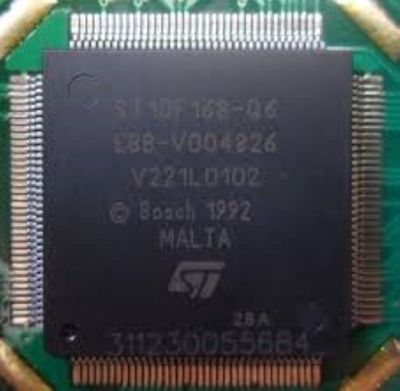
Typical applications of ST10F168
The ST10F168 and its relatives are commonly found in:
- Automotive control modules (engine, transmission, ABS, body control).
- Industrial automation (PLC peripherals, motor controllers, process instruments).
- Power management and metering devices.
- Consumer and professional instrumentation requiring deterministic control and analog integration.
Unique features that matter for recovery
The ST10 series combines real-time CPU performance with peripheral richness — watchdogs, timers, serial interfaces, and on-chip nonvolatile memories — which makes firmware critical and often secured. Its architecture and on-chip memory layout influence how firmware is stored (flash vs. EEPROM) and what recovery approaches are appropriate. Knowing these chip specifics reduces risk of data loss during readout and helps produce a more complete source of truth for clients.
Ethics, legality, and confidentiality
We require proof of ownership or authorization before attempting any firmware recovery, and we operate under strict confidentiality agreements. Our work is intended for lawful purposes: restore, repair, support legacy equipment, or perform authorized security audits. We do not assist with illegal copying or distribution of copyrighted or safety-critical software without explicit, lawful consent.
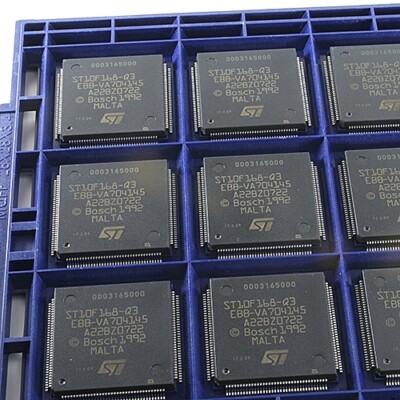
Deliverables & outcomes
Clients receive recoverable binary/heximal files, documented extraction reports, and optional high-level disassembly summaries to aid integration, testing, or migration. Where feasible and lawful, we can help translate low-level outputs into readable program representations to accelerate troubleshooting or redevelopment. If you need to copy chip ST10F168SQ6 software for legitimate recovery, maintenance, or audit purposes, our service provides secure, professional support focused on protecting your data and operational continuity.
Crack IC PIC12LC509 Security bits
Crack IC PIC12LC509 Security bits and decrypt microchip mcu pic12lc509 flash memory content out from it, extract secured code from pic12lc509 flash and eeprom memory in the format of heximal.
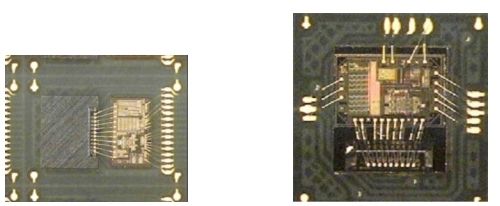
The MPLAB PM3 Device Programmer is a universal, CE compliant device programmer with programmable voltage verification at VDDMIN and VDDMAX for maximum reliability.
It features a large LCD display (128 x 64) for menus and error messages and a modular, detachable socket assembly to support various package types if recover mcu pic18f452 program.
The ICSP™ cable assembly is included as a standard item. In Stand-Alone mode, the MPLAB PM3 Device Programmer can read, verify and program PIC devices without a PC connection.
It can also set security bits protection in this mode. The MPLAB PM3 connects to the host PC via an RS-232 or USB cable.
The MPLAB PM3 has high-speed communications and optimized algorithms for quick programming of large memory devices and incorporates an SD/MMC card for file storage and secure data applications.
The PICSTART Plus Development Programmer is an easy-to-use, low-cost, prototype programmer. It connects to the PC via a COM (RS-232) port. MPLAB Integrated Development Environment software makes using the programmer simple and efficient if attack mcu tms320f241pg heximal.
The PICSTART Plus Development Programmer supports most PIC devices in DIP packages up to 40 pins. Larger pin count devices, such as the PIC16C92X and PIC17C76X, may be supported with an adapter socket.
The PICSTART Plus Development Programmer is CE compliant.
Posted in Break IC |
Tags: decap ic code, decap ic data, decap ic eeprom, decap ic file, decap ic firmware, decap ic lock bits, decap ic memory, decap ic program, decap ic security bits, decap ic software |
Comments Closed
Recover IC ATmega8PA Firmware
Recover IC ATmega8PA Firmware from embedded flash and eeprom memory, the secured firmware data can be readout from atmega8pa memory, crack atmega8pa protective system by removing the security fuse bit;
The AVR core combines a rich instruction set with 32 general purpose working registers. All the 32 registers are directly connected to the Arithmetic Logic Unit (ALU), allowing two independent registers to be accessed in one single instruction executed in one clock cycle.
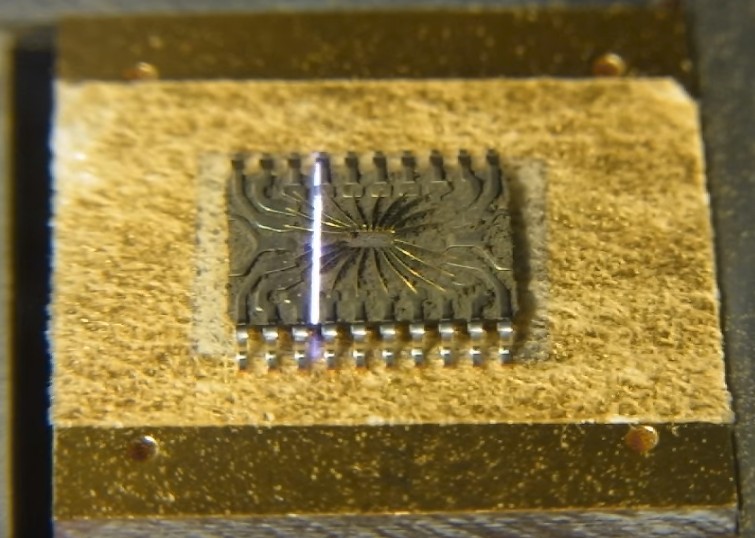
The resulting architecture is more code efficient while achieving throughputs up to ten times faster than conventional CISC microcontrollers. The ATmega8 provides the following features: 8K bytes of In-System Programmable Flash with Recover-While-Write capabilities, 512 bytes of EEPROM, 1K byte of SRAM, 23 general purpose I/O lines, 32 general purpose working registers, three flexible Timer/Counters with compare modes if Recover IC, internal and external interrupts, a serial programmable USART, a byte oriented Two-wire Serial Interface, a 6-channel ADC (eight channels in TQFP and QFN/MLF packages) with 10-bit accuracy, a programmable Watchdog Timer with Internal Oscillator, an SPI serial port, and five software selectable power saving modes before Reading avr chip embedded firmware.
The Idle mode stops the CPU while allowing the SRAM, Timer/Counters, SPI port, and interrupt system to continue functioning. The Power-down mode saves the register contents but freezes the Oscillator, disabling all other chip functions until the next Interrupt or Hardware Reset.
In Power-save mode, the asynchronous timer continues to run, allowing the user to maintain a timer base while the rest of the device is sleeping. The ADC Noise Reduction mode stops the CPU and all I/O modules except asynchronous timer and ADC, to minimize switching noise during ADC conversions.
In Standby mode, the crystal/resonator Oscillator is running while the rest of the device is sleeping. This allows very fast start-up combined with low-power consumption. The device is manufactured using Atmel’s high density non-volatile memory technology.
The Flash Program memory can be reprogrammed In-System through an SPI serial interface, by a conventional non-volatile memory programmer, or by an On-chip boot program running on the AVR core. The boot program can use any interface to download the application program in the Application Flash memory.
Software in the Boot Flash Section will continue to run while the Application Flash Section is updated, providing true Recover-While-Write operation. By combining an 8-bit RISC CPU with In-System Self Programmable Flash on a monolithic chip, the Atmel ATmega8 is a powerful microcontroller that provides a highly-flexible and cost-effective solution to many embedded control applications.
The ATmega8 AVR is supported with a full suite of program and system development tools, including C compilers, macro assemblers, program debugger/simulators, In-Circuit Emulators, and evaluation kits.
Posted in Recover Chip |
Tags: recover ic protected archive, recover ic protected code, recover ic protected content, recover ic protected data, recover ic protected eeprom, recover ic protected file, recover ic protected firmware, recover ic protected information, recover ic protected memory, recover ic protected program |
Comments Closed