 Attack Secured GD32F330C8T6 Software: LQFP48 64 KB Recovery
 August 18th, 2014 |
 Author:
The GD32F330C8T6 is the workhorse LQFP48 of the F330 line: a Cortex-M4 core at 84 MHz, 64 KB of flash, 8 KB of SRAM and 39 GPIO. It guards firmware across a whole generation of industrial boards, and it does so with a single mechanism — the security-protection level in its option bytes. To attack secured GD32F330C8T6 software is to attack that one decision, made once per reset, and to do it at precisely the right moment.
The decision that guards the array
Every reset, before any application code runs, the flash memory controller samples the security-protection level from the option bytes. Level 0 leaves the part open. Level 1 closes debug and bootloader access to the main array while the chip itself keeps working. Level 2 seals it permanently. The distinction matters because almost every locked C8T6 that reaches a bench sits at level 1: the board still runs its motors and its displays, but no programmer on earth will show it the flash contents. The part is not damaged — it is defending itself exactly as configured.
Why ordinary tools stop
The observable failure is always the same shape. The debug port enumerates and answers identification requests; the USART bootloader accepts a handshake; then the first attempt to read the array at 0x08000000 fails or returns nothing. Two interfaces, one gate. There is no debugger setting that opens it, because the gate was closed by the flash controller before the interfaces had a say. The same architecture protects the whole GigaDevice line, including the GD32F303C8T6 that shares this part’s exact footprint.
The glitch window
A security decision made in hardware, at a known point in the boot sequence, is a decision exposed to timing. If a short disturbance — a clock hiccup or a supply dip — lands on the cycle where the option-byte value is being evaluated, the check falls through and the part boots with the port open. The window is narrow, which is the point, but it is reachable with the right equipment. Our rigs and methods are documented for clock glitching and power glitching, and the C8T6 responds well: the LQFP48 gives stable, accessible pins to drive the disturbance into.
Streaming the 64 KB out
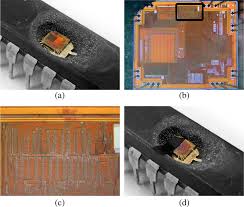
Once the port stays open, the capture is mechanical. The full array — code, constants, and the data pages this family keeps in flash instead of EEPROM — streams out in one session, taken twice and checksummed against itself. The option bytes are read alongside so the report can state the original lock level. Where level 2 is found instead, the electrical route is closed for good and the work moves to the package, as covered in our silicon decapsulation notes.
| Protection level | Port behaviour | Route |
|---|---|---|
| 0 – open | reads normally | none needed |
| 1 – read lock | refused on both interfaces | timed fault |
| 2 – sealed | refused permanently | decap and microprobe |
Limits of the method
Fault injection is a repeatable bench process, not a button. Each part type needs its window characterised, and a board that cannot be powered safely off-socket changes the setup. What the method never does is erase: an image is recovered or it is not, and the 64 KB stays intact either way. That is what separates an attack on the check from an attack on the chip.
When the part will not open
Most C8T6 units open on the first characterisation run, but a small share arrive uncooperative — a board with marginal supply decoupling under the fault, or a part already sitting at level 2. Level 1 always yields on the bench; level 2 does not, and there the route moves to the package, where the decapped die is read by probe rather than through the port. We flag an unyielding part early and tell you which route it needs before more bench time is spent, so the cost of a stubborn chip is known up front. The image either comes out whole or the attempt is reported honestly — the 64 KB is never traded for an erase.
From image to answer
The verified binary is delivered with the option-byte state, and analysis continues from there — a documented disassembly, a targeted value extraction, or a verified copy written to a blank part through the same flow used for the GD32F330C6T6 and the GD32F330R8T6. Send the locked part or the board it sits in; the first question we answer is which protection level the C8T6 is actually at.
 Posted in Recover MCU