Posts Tagged ‘break secured ic memory’
 Break PIC16F716 secured firmware
 August 23rd, 2012 |
 Author:
A request to break PIC16F716 secured firmware begins with the fact that PIC16F716 carries 2K words of 14-bit flash program memory and 128 bytes of data RAM and runs at 20 MHz in a 20-pin SSOP body. The work starts with the configuration word, because a mid-range PIC16 protects its program array with a single code-protect bit rather than a bank of lock bits.
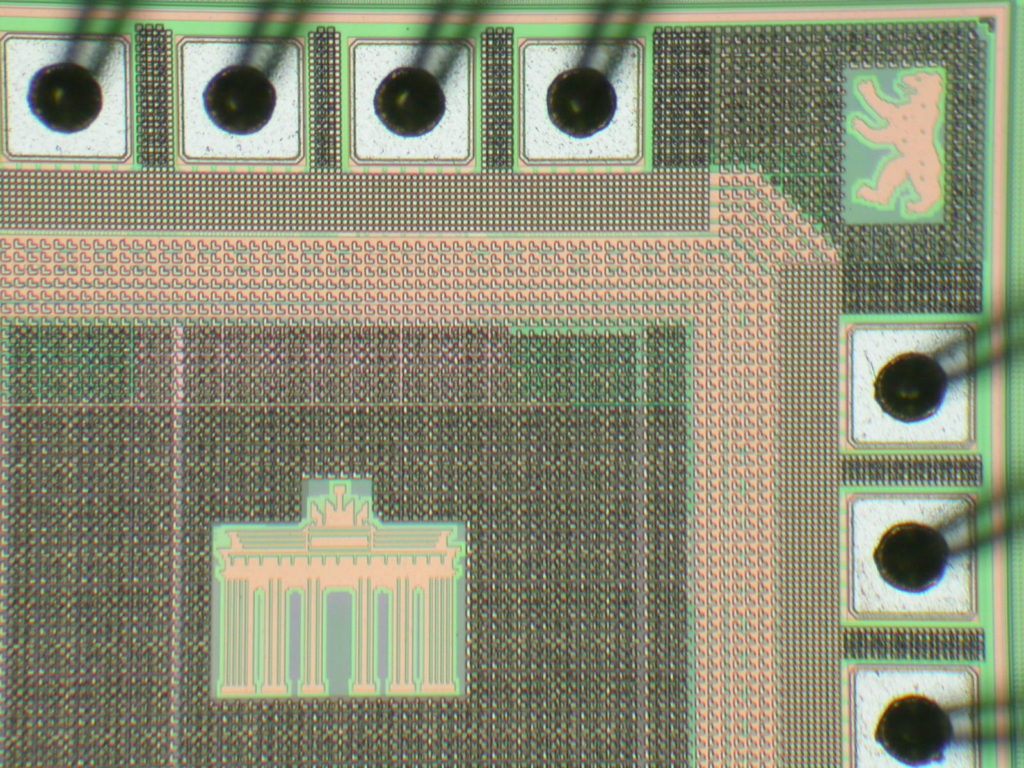
the first read in a break PIC16F716 secured firmware job
This PIC16 family uses a 14-bit instruction word and a single configuration word mapped at address 0x2007, outside the user program space and reachable only in programming mode. The code-protection bit, named CP0 on the larger members of this group and CP on the smaller flash parts, is the whole of the read-out control: left unprogrammed it allows normal reads, and programmed it protects the entire program array at once. ID locations and the configuration word itself remain readable even when the array is protected, which is why the first bench step is a read of 0x2007.
PIC16F716 program and data arrays and the erase coupling
On the PIC16F716 the program array holds 2K words of 14 bits, with 128 bytes of data RAM beside it and no data EEPROM on this member. There is no separate boot section and no separate data array to preserve, so the geometry question is simply how many words the programmer must return. Once code protection is enabled every program-memory location reads back as zeros and further programming of the array is disabled, while the ID locations and the configuration word still respond. The 20-pin SSOP body with 20 pins changes only the lead frame; the word count is fixed by the device number, not by the package suffix.
| PIC16F716 recovery geometry | Value |
|---|---|
| Program memory | 2K x 14-bit words of flash |
| Data EEPROM | no data EEPROM on this member |
| Data RAM | 128 bytes |
| Core and clock | 14-bit PIC16 core at 20 MHz |
| Protection | CP code-protect bit in the 0x2007 configuration word |
| Package | 20-pin SSOP, 20 pins |
the PIC16F716 interface once protection is set
In-circuit serial programming reaches the part over the clock and data pins with the programming voltage applied to the reset pin, and the same path reads the configuration word and the ID locations. What fails under an active code-protect bit is the array read: a verification pass returns zeros from every program-memory location while the part continues to execute its firmware normally. Disabling code protection is not a non-destructive unlock. The programming specification requires a chip erase command, which erases the program memory first and then the configuration memory, and in doing so clears the code-protect bit back to the unprotected state. The practical routes are therefore a clean read while CP is off, or an erase that the customer must approve in writing because it removes the program along with the protection.
a decision tree for break PIC16F716 secured firmware
Read the configuration word at 0x2007 first and check the code-protect bit, because that single bit settles whether any firmware can be read at all. With protection off the array reads cleanly and the heximal can be assembled directly from the returned words. With protection on there is no partial read and no selective block to keep, so the only route to a blank device is the chip erase with its permanent cost. The PIC16F716 is the 2K words of 14-bit program memory device in a 20-pin SSOP body, so the capacity marking and the package settle the array size before anything is priced. The 20-pin body, the enhanced capture compare PWM module and the dual-level brown-out reset identify this member. What survives the protection: the configuration word, the ID locations, the device ID word at 0x2006 and the register contents the running firmware exposes.
sibling parts of the PIC16F716
When a board carries only a partial marking, the mid-range PIC16 flash family is the place to look, because its members share the 14-bit core, the 0x2007 configuration word and the same code-protect behaviour while differing in program words, RAM, pin count and peripherals such as the ADC and the capture compare module. Neighbouring members span 2K to 8K words of program memory in 18-pin to 40-pin bodies, all using the same 14-bit core and the same single code-protect bit, with no data EEPROM anywhere in this group. Reading the device ID word at 0x2006 against the package marking settles which member is on the board before any protection work begins.
Comparable recoveries are documented in attack ic pic12f510 program, attack ic pic16c74b binary, attack ic pic16f54 eeprom, attack ic pic16f57 program and attack ic pic18lf4520 program, each starting from the configuration read.
closing out a break PIC16F716 secured firmware request
For a board that arrived as a break PIC16F716 secured firmware request, the deliverable is a confirmed word count, a code-protect state and a priced route agreed in writing before any destructive step, and our engineers read the configuration word at 0x2007 first.
 Posted in
 Tags:
