 Solar’s new player – Foxconn?
 August 15th, 2013 |
  Author:
 An industry that has seen its ups and downs – and most recently a streak of ‘downs’ – we’re talking about the solar industry of course. And now, the industry might see a new player entering the already crowded field.
The electronics giant that is Hon Hai Precision Industry is apparently eyeing the industry, and according to some analysts, the company might end up timing their entry just right, as the sector is starting to show some positive signs.
Foxconn, the trading name Hoi Hai has tested the marker through its Fox Energy solar unit for about two years now, but little is know about the subsidiary, other than that it has a solar panel facility in eastern China.
But in an interview with Reuters, Foxconn spokesman Simon Hsing stated that the company is to make a decision if to enter the market by years end.
“We believe renewable energy is a potentially good trend. It looks like a good project. This is an industry we probably need to know more about,” he added.
Read more: http://evertiq.com/news/32255
 Posted in PCB Repair |
  Tags: crack LG chip binary file, crack LG chip dump information, crack LG chip embedded firmware, crack LG chip encrypt program, crack LG chip flash content, crack LG chip heximal data, crack LG chip locked archive, crack LG chip protect eeprom, crack LG chip software memory, crack LG chip source code |
  Comments Closed
FIH Mobile found its way back to profit
Restructuring and cost-saving initiatives seems to have turned FIH Mobile (previously Foxconn International Holdings) back to profit in 1H13.
The handset maker reported a net profit of USD 17’66 million for the 1H13, compared to the USD 226.07 million loss during 1H12.
If this keeps up, FIH would be on track to post a net profit for the full year – which would be a giant leap from the loss of USD 316.4 million in 2012.
The company reviews its first half of 2013 by stating:“The increase in profit is mainly attributable to the Group’s improved gross profit margins principally as a result of the corresponding improvement in the Group’s yield and operation efficiency, as well as control of the Group’s cost of sales and general and administrative expenses and optimisation of its research and development resources. Also, no asset impairment loss was recorded during the period (2012: USD 56 million),” The company states.
Looking forward, FIH Mobile has a rather reserved outlook, citing that the global economy still has some recovery to do.
”Customers’ trend of outsourcing also directly affects our business. Market share reshuffling among our customers will continue and it will need time and efforts to develop new customers and new businesses for manufacturing other mobile devices. Orders of new customers will need time to be sizeable enough to boost utilisation significantly”, the company rites in a statement.
Read more: http://evertiq.com/news/32232
Posted in PCB Repair |
Tags: extract cpld mcu binary file, extract cpld mcu data memory, extract cpld mcu dump information, extract cpld mcu embedded firmware, extract cpld mcu encrypt program, extract cpld mcu flash eeprom, extract cpld mcu heximal content, extract cpld mcu locked archive, extract cpld mcu protect software, extract cpld mcu source code |
Comments Closed
REC issues convertible bond loan
Norwegian solar company REC, Renewable Energy Company ASA, proposes to improve its debt maturity profile through issuing a new convertible bond loan maturing in 2018.
REC ASA has mandated Arctic Securities ASA to explore the potential issuance of up to USD 110 million (NOK 643 million) in principal amount of convertible bonds with maturity on September 13, 2018.
In conjunction with the issue of the New Convertible Bond Loan, REC ASA will offer to repurchase and exchange bonds in the Company’s Subordinated Unsecured Convertible Bond Issue 2009/2014 for a principal amount of up to EUR 112 million (NOK 876 million), including accrued interest since the July 4, 2013 interest payment date.
Posted in PCB Repair |
Tags: extract atmel ic binary file, extract atmel ic dump information, extract atmel ic embedded firmware, extract atmel ic encrypt program, extract atmel ic flash data, extract atmel ic heximal content, extract atmel ic locked archive, extract atmel ic protect eeprom, extract atmel ic software memory, extract atmel ic source code |
Comments Closed
PCB Manufacturer Found Guilty of ITAR Violations
A Woodinville, Wash. company contracted by the U.S. Navy to manufacture high-tech components, and the company’s owner recently pleaded guilty to violating the Arms Export Control Act, according to an ICP slog post.
The owner of Precision Image Corporation admitted to illegally sending restricted U.S. Navy technical information to a Taiwanese printed board (PCB) manufacturer that was subcontracted to make the printed boards.
The information sent to the Taiwanese PCB manufacturer contained the technical specifications for the printed boards – information listed on the United States Munitions List (USML) and controlled by U.S. International Traffic in Arms Regulations (ITAR) and therefore prohibited from being transmitted outside the U.S. without a license from the State Department.
For the past two years, IPC has been promoting a better understanding of ITAR’s applicability to PCBs in order to protect national security. Launched in July 2012, IPC’s Follow the Law, Protect the Board initiative sought to raise awareness and promote compliance with federal regulations on the export of printed boards designed for ITAR-controlled equipment.
Read more: http://evertiq.com/news/32203
Posted in PCB Repair |
Tags: extract pic microchip binary file, extract pic microchip data memory, extract pic microchip dump information, extract pic microchip embedded firmware, extract pic microchip encrypt program, extract pic microchip flash eeprom, extract pic microchip heximal content, extract pic microchip locked archive, extract pic microchip protect software, extract pic microchip source code |
Comments Closed
German component distribution market grows again
The German component distribution market (according to FBDi eV) grew during the second quarter of 2013 with 2.3%. Orders registered above-average growth.
The state of the German component distribution market is beginning to improvements. According to the FBDi, sales figures increased for the second quarter with 2.3 percent to EUR 712 million compared to the same quarter 2012. The book-to-bill ratio stood at 1.02 (0.96 for the same period last year). The first half ended almost balanced – both turnover and order intake stood at EUR 1.44 billion – which is a promising sign for the second half of the year.
When considering the various component groups, figures for the semiconductor segment have a lot to be desired for: a meager growth of 0.7% to EUR 484 million in turnover. However, order intake was up 8.5% and stood at EUR 497 million. This results in a market share (total component distribution market) of 68%.
This is followed by passive components with a turnover increase of 6.9% to EUR 108 million (representing a 15% market share). With an increase of 3.4% to EUR 75 million in turnover, the segment Electromechanical reached a market share of over 10%. The rest is split between displays, power supplies and sensors.
Read more: http://evertiq.com/news/32198
Posted in PCB Repair |
Tags: extract cpld ic binary file, extract cpld ic dump information, extract cpld ic embedded firmware, extract cpld ic encrypt program, extract cpld ic flash content, extract cpld ic heximal data, extract cpld ic locked archive, extract cpld ic protect eeprom, extract cpld ic software memory, extract cpld ic source code |
Comments Closed
Reverse LATTICE CPLD Source code
Reverse LATTICE CPLD source code is a process to extract jed file from encrypted Lattice CPLD, using physical MCU invasive cracking method include decapsulation and focus ion beam can help to fulfill the task;
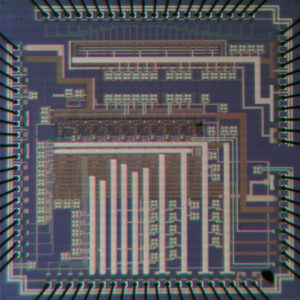
Reverse LATTICE CPLD source code is a process to extract jed file from encrypted Lattice CPLD, using physical MCU invasive cracking method include decapsulation and focus ion beam can help to fulfill the task
The same memory type but built with newer technologies such as 0.9 µm in the Microchip PIC16CR57 microcontroller [124] and 1.0 µm in the Motorola MC68HC705C9A microcontroller [23] requires deprocessing because the top bit-line metal wires obstruct observation of the transistors.
NAND Mask ROM memory type with metal layer programming was used in the NEC µPD78F9116 microcontroller [125] fabricated with 0.35 µm technology. As all the internal layers were planarised, deeper layers cannot be observed unless the top metal layer is removed.
This was accomplished by using Nitrox etching for the passivation layer followed by treatment in a 33% water solution of KOH to etch the top aluminium metal layer but preserving the interconnection layer which is probably made out of tungsten (because when the HCl solution was used to etch the top metal layer, the interconnection layer was etched away as well).
Posted in Break IC |
Tags: extract fpga ic binary file, extract fpga ic dump information, extract fpga ic embedded firmware, extract fpga ic encrypt program, extract fpga ic flash content, extract fpga ic heximal data, extract fpga ic locked archive, extract fpga ic protect eeprom, extract fpga ic software memory, extract fpga ic source code |
Comments Closed
Reverse DSP CPLD IC Chip Program
Reverse DSP CPLD IC Chip Program from memory, and copy memory content to new CPLD chip which will provide the same functions as original DSP chip by Crack CPLD protection.
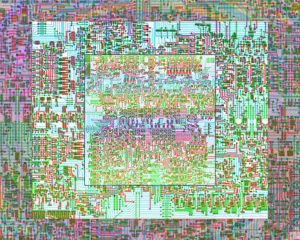
Reverse DSP CPLD IC Chip Program from memory, and copy memory content to new CPLD chip which will provide the same functions as original DSP chip by Crack CPLD protection
Layout reconstruction requires the images of all the layers inside the chip to be combined. The images are normally taken automatically using a motorised stage to move the sample and special software to combine all the images together.
Normally, for semiconductor chips fabricated with 0.13 µm or smaller technology, images are created using a SEM which has a resolution better than 10 nm.
Posted in Break IC |
Tags: extract avr microcontroller binary file, extract avr microcontroller dump information, extract avr microcontroller embedded firmware, extract avr microcontroller encrypt program, extract avr microcontroller flash content, extract avr microcontroller heximal data, extract avr microcontroller locked archive, extract avr microcontroller protect eeprom, extract avr microcontroller software memory, extract avr microcontroller source code |
Comments Closed
Read Lattice CPLD embeded firmware
Read Lattice CPLD embeded firmware from locked memory, the file format of CPLD can be JED, unlock CPLD tamper resistance system by cut off the security fuse.
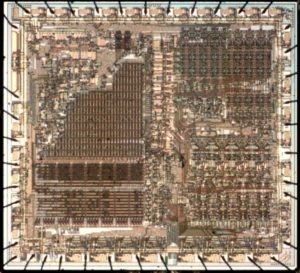
Read Lattice CPLD embeded firmware from locked memory, the file format of CPLD can be JED, unlock CPLD tamper resistance system by cut off the security fuse
The main disadvantage of high resolution microscopes is the short working distance between the objective and a specimen, especially at high magnifications (about 0.3 mm with 100× objective). As a result partially decapsulated chips cannot be observed and full decapsulation of the die is required. Using microscopes with a long working distance, for example the Mitutoyo FS70 [121] with 13 mm working distance on 200× objective, helps solve this problem but at a cost: the resolution is at most 0.4 µm because the NA cannot be high.
Another problem of the high-resolution objectives is a very short depth of focus, which makes the out-of-focus planes look blurred, thus reducing the image quality. This is more noticeable on multilayer chips where the distance between the top and the bottom layer is more than 1 µm.
Confocal microscopy reduces this effect as all out-of-focus planes become dark or appear in different colours depending from their depth. Such confocal systems are very expensive, especially the ones that use laser scanning, and therefore can be afforded by relatively large labs only. Even second-hand confocal microscopes start from £10,000.
Posted in Break IC |
Tags: extract atmel microcontroller binary file, extract atmel microcontroller dump information, extract atmel microcontroller embedded firmware, extract atmel microcontroller encrypt program, extract atmel microcontroller flash content, extract atmel microcontroller heximal data, extract atmel microcontroller locked archive, extract atmel microcontroller protect eeprom, extract atmel microcontroller software memory, extract atmel microcontroller source code |
Comments Closed
Reverse Microchip PIC18F2220 MCU Flash Program
Reverse Microchip PIC18F2220 MCU Flash Program
During interrupts and subroutine calls, the return address PC is stored on the Stack. The Stack is effectively allocated in the general data SRAM, and consequently the Stack size is only limited by the total SRAM size and the usage of the SRAM from Reverse Microchip PIC18F2220 MCU Flash Program. After reset the Stack Pointer (SP) points to the highest address in the internal SRAM.
The SP is read/write accessible in the I/O memory space, enabling easy implementation of multiple stacks or stack areas. The data SRAM can easily be accessed through the five different addressing modes supported in the AVR CPU.The AVR architecture has two main memory spaces, the Program Memory and the Data Memory.
In addition, the XMEGA A3 features an EEPROM Memory for non-volatile data storage. All three memory spaces are linear and require no paging. The available memory size configurations are shown in ”Ordering Information” on page 2. In addition each device has a Flash memory signature row for calibration data, device identification, serial number etc. Non-volatile memory spaces can be locked for further write or read/write operations.
This prevents unrestricted access to the application software. The XMEGA A3 devices contains On-chip In-System Programmable Flash memory for program storage, see Figure 7-1 on page 10. Since all AVR instructions are 16- or 32-bits wide, each Flash address location is 16 bits. The Program Flash memory space is divided into Application and Boot sections.
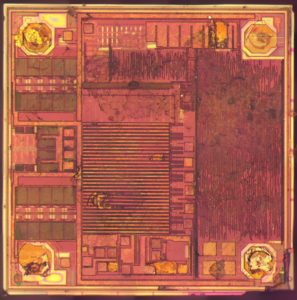
Reverse Microchip PIC18F2220 MCU Flash Program
Both sections have dedicated Lock Bits for setting restrictions on write or read/write operations. The Store Program Memory (SPM) instruction must reside in the Boot Section when used to write to the Flash memory before the code.
A third section inside the Application section is referred to as the Application Table section which has separate Lock bits for storage of write or read/write protection. The Application Table section can be used for storing non-volatile data or application software from MCU CRACK.
Copy Encrypted Microchip PIC18F2330 Heximal
Copy Encrypted Microchip PIC18F2330 Heximal
The Flash Program Memory and firmware data memory are organized in pages which can be Copy Encrypted Microchip PIC18F2330 Heximal. The pages are word accessible for the Flash and byte accessible for the firmware. Table 7-2 on page 14 shows the Flash Program Memory organization.
Flash write and erase operations are performed on one page at a time, while reading the Flash is done one byte at a time. For Flash access the Z-pointer (Z[m:n]) is used for addressing. The most significant bits in the address (FPAGE) gives the page number and the least significant address bits (FWORD) gives the word.
Table 7-3 on page 14 shows firmware memory organization for the PIC18F2320 devices. Efirmware write and erase operations can be performed one page or one byte at a time, while reading the firmware is done one byte at a time.
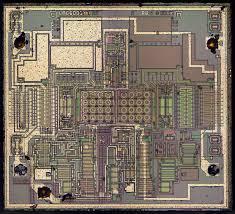
Copy Encrypted Microchip PIC18F2330 Heximal
For firmware access the NVM Address Register (ADDR[m:n]) is used for addressing. The most significant bits in the address (E2PAGE) gives the page number and the least significant address bits (E2BYTE) gives the byte.
The PIC18F2320 has a Direct Memory Access (DMA) Controller to move data between memories and peripherals in the data space. The DMA controller uses the same data bus as the CPU to transfer data. It has 4 channels that can be configured independently. Each DMA channel can perform data transfers in blocks of configurable size from 1 to 64K bytes.
A repeat counter can be used to repeat each block transfer for single transactions up to 16M bytes. Each DMA channel can be configured to access the source and destination memory address with incrementing, decrementing or static addressing. The addressing is independent for source and destination address.
When the transaction is complete the original source and destination address can automatically be reloaded to be ready for the next transaction. The DMAC can access all the peripherals through their I/O memory registers, and the DMA may be used for automatic transfer of data to/from communication modules, as well as automatic data retrieval from ADC conversions, data transfer to DAC conversions, or data transfer to or from port pins.
A wide range of transfer triggers is available from the peripherals, Event System and software. Each DMA channel has different transfer triggers. To allow for continuous transfers, two channels can be interlinked so that the second takes over the transfer when the first is finished and vice versa. The DMA controller can read from memory mapped firmware, but it cannot write to the firmware or access the Flash before CRACK MCU.