 Copy STM8S003F3 Microprocessor Flash Memory Content
 November 14th, 2020 |
 Author:
The STM8S003F3 is one of the cheapest and most widely used 8-bit microcontrollers in cost-sensitive designs, and its read-out protection is correspondingly common in the field. Understanding how that protection is implemented — and therefore what “breaking” it can and cannot mean — is the foundation for any legitimate recovery work on a locked device.
The part in context
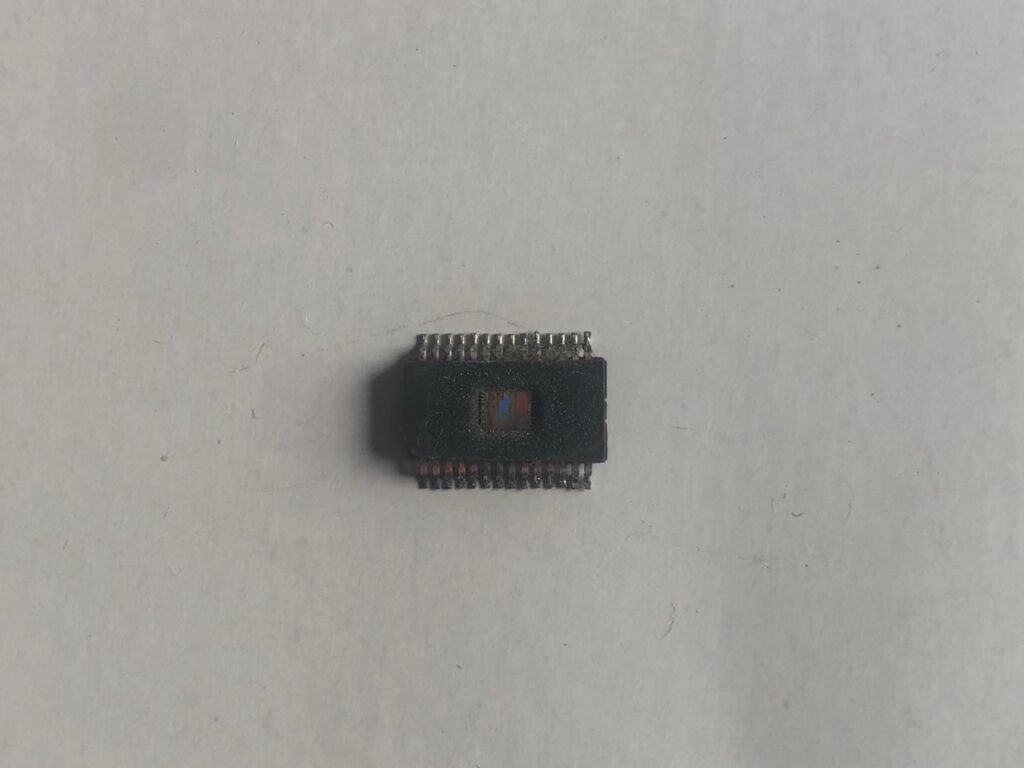
The STM8S003F3 is a member of ST’s STM8S series: an 8-bit STM8 core running at up to 16 MHz, with 8 KB of flash, 1 KB of RAM, and 128 bytes of EEPROM. It is programmed and debugged over SWIM (Single Wire Interface Module), a single-wire debug protocol that also provides in-circuit programming. That single wire is both the development interface and the protection boundary.
How ROP is implemented
Read-out protection on the STM8S family is stored in the option bytes, a small configuration area that is read at reset and governs device behaviour before user code runs. The relevant setting is the ROP option byte, which has two meaningful states:
| ROP state | Value | Effect on SWIM access |
| Unprotected | 0xAA | Flash and EEPROM readable over SWIM |
| Protected | any other value | Read of flash and EEPROM blocked over SWIM |
When ROP is active, the SWIM interface will still allow certain operations — the device can be identified and, in some configurations, erased — but it will not return the contents of the program memory. This is enforced by the on-chip debug logic, not by the programmer, which is why no SWIM tool can simply request the bytes.
The erase trap
This is the detail that defines the problem. On the STM8S003F3, removing ROP through the sanctioned path — writing the option bytes back to their unprotected value — triggers a mass erase of the program memory. The protection can therefore be removed, but the program it protected is destroyed in the process.
That asymmetry is the whole reason a “break” is a technical problem at all: the chip is designed so that the safe, documented path and the goal of preserving the firmware are mutually exclusive.
What breaking it involves, technically
Because the lock is a hardware state, the approaches are the same families that appear across the microcontroller world, adapted to the STM8’s architecture.
- Option-byte analysis. Establishing the exact ROP state and the device’s silicon revision is the first step; behaviour differs between revisions, and some documented attack paths apply only to specific ones.
- Fault injection. The ROP check is evaluated by the chip’s logic during debug access. Introducing precisely timed disturbances — a voltage glitch on VDD, or a clock perturbation during the option-byte read or the SWIM handshake — can cause the check to be mis-evaluated for a single cycle, allowing a read before protection reasserts. These methods are non-invasive and preserve the die, but they are timing-critical and not guaranteed across revisions.
- Invasive analysis. When electrical approaches fail, decapsulation and microprobing of the flash array become the remaining route. This destroys the package and is reserved for cases where the firmware is irreplaceable.
Each of these is studied in security research and used in authorised recovery, always premised on the requester owning the design or holding written authorisation.
Why locked STM8S003F3 devices turn up
The STM8S003F3’s low cost makes it a favourite for high-volume consumer and industrial products, and high-volume products are exactly the ones that outlive their documentation. A supplier change, a lost build server, or a discontinued contract manufacturer can leave a working board as the only record of the firmware. In those cases, ROP is not protecting against an attacker — it is accidentally protecting the owner from their own archive.
FAQ
Can ROP be removed without erasing the flash? Not through the documented path. Clearing ROP via option bytes triggers a mass erase on this family. Approaches that preserve the program work by bypassing the check, not by disabling it.
Is SWIM the only access route? SWIM is the intended debug and programming interface. The bootloader path in system memory offers programming but does not expose read-back of protected memory.
Do all STM8S003F3 revisions behave the same? No. Silicon revisions differ in their response to fault-injection techniques, which is why identifying the revision is a required first step rather than an optional one.
Conclusion
Read-out protection on the STM8S003F3 is a small option-byte setting enforced by the debug logic, with a mass erase as the only sanctioned way out. Understanding that structure — the two states, the erase trap, and the revision-dependent nature of any bypass — is what allows an engineer to reason about a locked part instead of guessing at it.
 Posted in Recover Chip