 Duplicate Protected STM32G030K8T6 Binary: LQFP32 64 KB Copy
 November 17th, 2012 |
 Author:
End-of-life boards become irreplaceable the moment the last spare is gone, and the STM32G030K8T6 is exactly that kind of part. It is the 64 KB flash member of the G0 value line in an LQFP32 body, an Arm Cortex-M0+ at 64 MHz with 8 KB of SRAM on control boards never meant to be serviced. To duplicate protected STM32G030K8T6 binary you need more than the array: the duplicate has to carry the option bytes or the replacement will not behave like the original.
Why duplicates are needed at end of life
When a board goes out of production the firmware often exists nowhere but the devices already in the field, and because designers lean on the 64 KB, the lost program tends to be the one that matters most. A duplicate is the practical answer: read one surviving locked unit and write the result onto fresh parts so repair continues. Our firmware cloning process exists for this continuity, and the STM32G030C8T6 clone is the same idea in an LQFP48.
The option bytes are part of the duplicate
A 64 KB flash dump alone is not a faithful duplicate. The STM32G030K8T6 holds its read protection, write protection and boot configuration in option bytes outside the main array, and a blank replacement boots open with every protection cleared. Drop only the array onto it and the clone may start differently or refuse to run, so the duplicate bundles the option bytes with the image. The lock state is data, not an obstacle to ignore, as our flash protection methods notes make clear.
Reading a locked part through the package
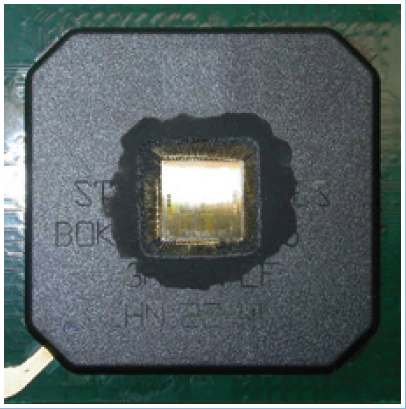
With RDP at level 1 the SWD port links and then declines the flash window, and the USART bootloader read command does the same, because the security level is sampled out of reset and gates both. The G0 family has no USB, so there is no DFU path. When the electrical route is shut we etch the LQFP32 open, keep the die live, and apply an optical fault at the boot security check to hold the port open long enough to stream the 64 KB out; microprobing is the alternative. The decapsulation service covers this body and the STM32G030C6T6.
The LQFP32 body is comfortable work because the die sits centred in a 7×7 mm package, so the compound comes off without cutting between leads. The part is never desoldered, which makes a timed fault possible: the check that gates the array is evaluated in the first instants after reset, and the fault has to land inside that window.
A supply or clock perturbation can widen the same comparison window without opening the package, and since a failed attempt leaves the part locked rather than harming the image, those are tried first while the leads are accessible. Our power glitch and clock glitch notes cover the two variants.
Checking the duplicate is faithful
| Element | In dump | In duplicate | Effect if missing |
|---|---|---|---|
| Main flash | yes | yes | nothing runs |
| Option bytes | yes | must be | wrong boot or lock |
| Checksum | yes | verified | silent corruption |
| Blank-write test | no | performed | clone unproven |
Verification separates a duplicate from a guess. The array is read twice and the passes are checksummed; a mismatch means the port closed mid-read and the block is captured again. The option bytes go into the same file, and a blank-write test proves the duplicate is readable and runnable.
The write sequence is deliberate as well. The option bytes are programmed first, because they carry the boot configuration and the protection state the replacement has to match, and a part left on defaults either boots into the wrong mode or presents a debug port the original never had. The 64 KB follows in the correct order, then the part is reset and checked for the same start-up behaviour as the unit it replaces. Where the board is available, our dual probe and flying probe checks confirm the electrical side as well. Where the goal is understanding rather than copying, the source reconstruction stands in for the lost project. The neighbouring STM32G030K6T6 memory decode follows the same pipeline at 32 KB.
What the finished duplicate includes
You receive the full 64 KB binary, the option-byte record that pins the original lock and write-protection state, and a verification report listing both read passes and their checksums. A disassembly-based source reconstruction is available when the aim is to read the logic rather than merely reproduce it. Where the target is a working spare board, the same verified image is programmed into a blank part, and the STM32G030J6M6 source break shows that step taken further on the eight-pin body.
 Posted in Break IC